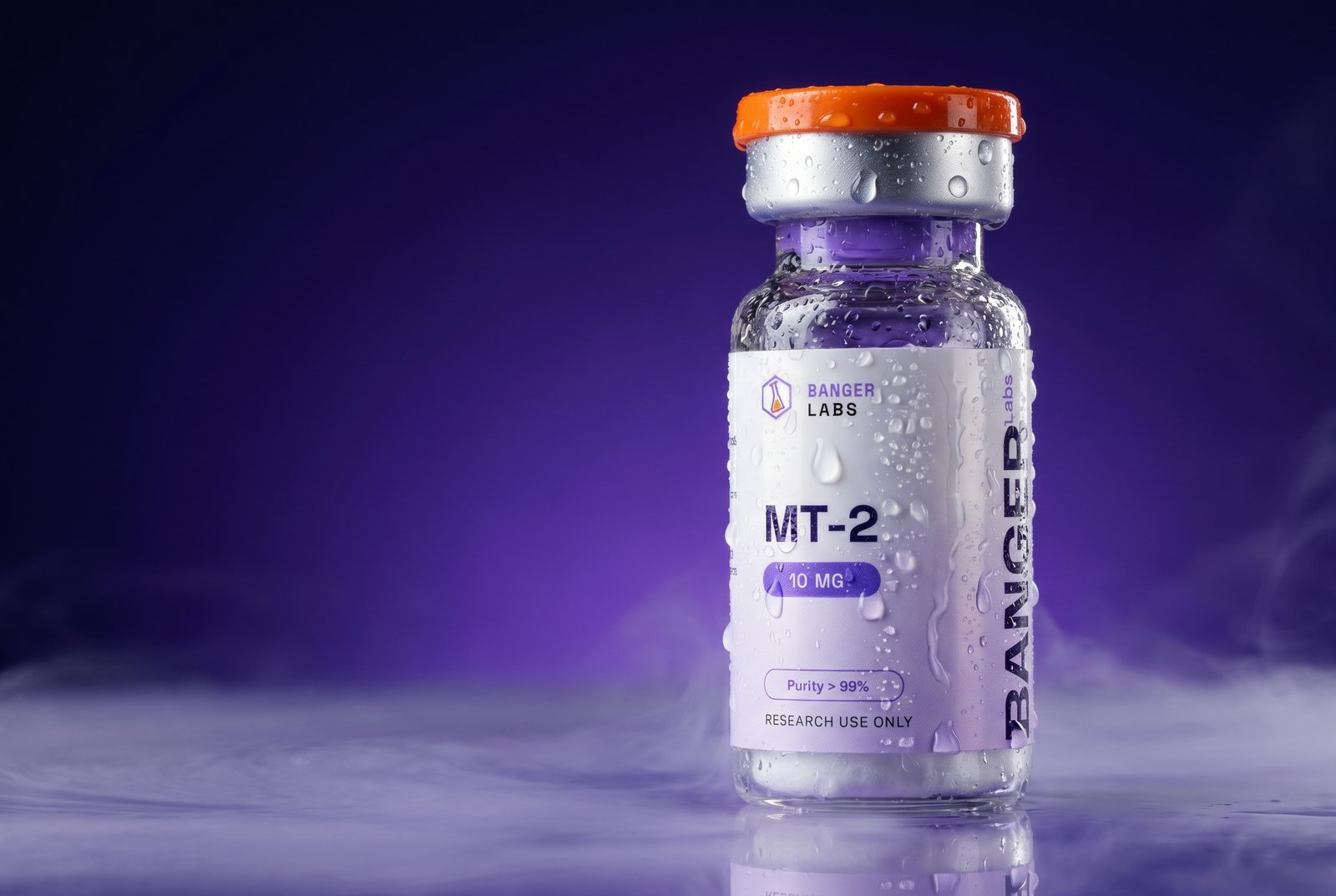
MT-1 and MT-2 are both synthetic analogs of alpha-melanocyte-stimulating hormone (α-MSH), the natural peptide that activates the melanocortin receptor family. The two are frequently grouped together as “Melanotan,” but in the preclinical and pharmacological literature they are distinct molecules with meaningfully different receptor profiles: MT-1 is the more selective analog, while MT-2 is a broadly active, conformationally constrained analog whose off-target activity at one receptor subtype gave rise to an entirely separate research peptide, PT-141. This guide contrasts the two molecules at the level of structure, receptor selectivity, and research context. Everything here is for research use only — not for human consumption, and every mechanism below is drawn from in-vitro, animal, or pharmacological literature, labeled as such.
The melanocortin system in brief
To compare MT-1 and MT-2 you first need the receptor map they act on. The melanocortin system is a family of five G-protein-coupled receptors (MC1R through MC5R), each with a different tissue distribution and downstream role established in the cell-biology and animal literature.
- MC1R — expressed on melanocytes; its activation drives the cyclic-AMP signaling that increases eumelanin synthesis in preclinical models. This is the receptor most associated with pigmentation research.
- MC2R — the adrenocorticotropic hormone (ACTH) receptor; not a meaningful target for α-MSH analogs.
- MC3R / MC4R — central receptors studied in animal models of energy balance, feeding behavior, and, for MC4R, sexual-arousal pathways.
- MC5R — implicated in exocrine gland function in rodent studies.
Native α-MSH activates several of these receptors but is rapidly degraded. The synthetic analogs were designed in academic medicinal-chemistry programs to resist breakdown and, in some cases, to bias activity toward particular subtypes. That design difference is the whole story of MT-1 versus MT-2.
MT-1 (afamelanotide): the selective analog
MT-1 is also written as MT-I and is known in the pharmacology literature by the development name afamelanotide (a linear, modified α-MSH analog, [Nle4, D-Phe7]-α-MSH, historically abbreviated NDP-MSH). It is the more receptor-selective of the two, with activity oriented toward MC1R — the pigmentation receptor.
Because its profile is comparatively focused, MT-1 is the analog that appears most often in the published melanocortin-1 pigmentation literature and in the formal pharmaceutical development record for a rare-disease photoprotection indication. In research contexts it is studied as a tool compound for probing MC1R-driven cyclic-AMP signaling and melanogenesis in cultured melanocytes and animal models. None of that constitutes a human-use recommendation; in a research setting MT-1 is handled strictly as a specialty compound.
You can review the MT-1 product page for the specification and certificate-of-analysis information relevant to characterizing the material before any in-vitro work.
MT-2 (Melanotan II): the broad-spectrum analog
MT-2 (MT-II, Melanotan II) is a cyclic, conformationally constrained α-MSH analog. Where MT-1 is comparatively selective, MT-2 is a broad melanocortin agonist with documented activity across multiple receptor subtypes in binding and functional assays — including MC1R, MC3R, and MC4R. That breadth is the defining characteristic and the reason its research literature is wider than pigmentation alone.
In animal models, MT-2’s activity at central melanocortin receptors (MC3R/MC4R) is what links it to studies of feeding behavior and sexual-arousal pathways, in addition to the MC1R-mediated pigmentation effects it shares with MT-1. Again, these are preclinical observations reported in the literature, not endorsed human outcomes.
The MT-2 product page carries the relevant purity and COA details. As with any lyophilized peptide, correct reconstitution and cold storage materially affect assay reproducibility — see the reconstitution and storage guide.
Side-by-side comparison
The table below summarizes the practical differences researchers tend to care about. All entries reflect properties reported in the pharmacology and preclinical literature, not clinical guidance.
| Attribute | MT-1 (MT-I / afamelanotide) | MT-2 (MT-II / Melanotan II) |
|---|---|---|
| Structure | Linear modified α-MSH analog (Nle4, D-Phe7) | Cyclic, conformationally constrained α-MSH analog |
| Receptor profile | More selective, oriented toward MC1R | Broad agonist across MC1R, MC3R, MC4R |
| Primary research association | MC1R-driven melanogenesis / pigmentation | Pigmentation plus central MC3R/MC4R pathways |
| Notable derivative | — | PT-141 (bremelanotide) derived from this scaffold |
| Selectivity, in one word | Focused | Broad |
| Category | Specialty research peptide | Specialty research peptide |
The short version: if a research question is specifically about MC1R and pigmentation pathways, MT-1 is the more selective tool. If the question involves the broader melanocortin system — including central receptors — MT-2 is the broader-acting analog, with the caveat that breadth also means more off-target activity to account for in experimental design.
How researchers choose between them
Match the molecule to the receptor question
- Define the target subtype. If your assay is MC1R-specific (melanocyte cyclic-AMP, melanin output), MT-1’s selectivity reduces confounding signal from other receptors.
- Account for breadth. If you use MT-2, plan controls for its MC3R/MC4R activity — what reads as a pigmentation result may be entangled with central-receptor effects in whole-animal models.
- Characterize the material first. Confirm identity and purity against the certificate of analysis before drawing any conclusions; broad agonists are especially sensitive to impurity-driven artifacts.
For verifying material quality, our guides on how to read a peptide COA and what “research use only” actually means are the right starting points.
Selectivity is not a ranking of quality — it is a property to be matched to the experimental question. The ‘better’ melanocortin analog is the one whose receptor profile fits the assay.
Compliance and handling
Both MT-1 and MT-2 are sold and described here strictly for laboratory research use — not for human consumption, injection, or any therapeutic application. Nothing on this page is a dosing protocol, a usage cycle, or a medical claim, and none of the cited effects should be read as endorsed human outcomes. The pigmentation, feeding, and arousal-pathway observations referenced above come from in-vitro and animal studies and are presented only to characterize the molecules’ pharmacology.
- Store lyophilized material per the product specification; reconstitute only with appropriate laboratory diluent for in-vitro work.
- Document lot, purity, and COA for every experiment.
- Review the full research disclaimer before ordering.
Common questions
Are MT-1 and MT-2 the same thing as ‘Melanotan’?
‘Melanotan’ is used loosely for both. Strictly, MT-1 (MT-I, afamelanotide) and MT-2 (MT-II, Melanotan II) are two distinct synthetic α-MSH analogs. MT-1 is the more MC1R-selective molecule; MT-2 is a broad melanocortin agonist. They are not interchangeable in research.
What is the main receptor difference between MT-1 and MT-2?
In binding and functional assays, MT-1 is oriented more selectively toward MC1R (the pigmentation receptor), while MT-2 shows broad activity across MC1R, MC3R, and MC4R. That breadth is why MT-2 appears in a wider preclinical literature than pigmentation alone.
How is PT-141 related to MT-2?
PT-141 (bremelanotide) was derived from the MT-2 scaffold. Researchers studying MT-2 observed MC4R-mediated effects distinct from pigmentation, and that work led to PT-141, a more MC4R-focused peptide studied for arousal-pathway signaling rather than melanogenesis.
Which one is more selective?
MT-1 is the more selective analog (focused toward MC1R). MT-2 is broader. Neither is universally ‘better’ — the right tool depends on which melanocortin receptor your assay is designed to probe.
Can these peptides be used on humans?
No. Both are offered for laboratory research use only — not for human consumption, injection, or any therapeutic use. This article describes preclinical and pharmacological properties only and provides no dosing or usage protocols.
Related research reading
References
- Hadley ME, Dorr RT. Melanocortin peptide therapeutics: historical milestones, clinical studies and commercialization. Peptides. 2006. (Review of α-MSH analogs including NDP-MSH/afamelanotide and Melanotan II.)
- King SH, et al. / Molecular Pharmacology literature on melanocortin receptor subtypes (MC1R–MC5R) binding and signaling — see PubChem and NCBI entries for melanocortin receptors: https://www.ncbi.nlm.nih.gov/gene/4157 (MC1R)
- Pfaus JG, et al. Bremelanotide (PT-141): an MC4R-focused melanocortin agonist derived from melanocortin-II analog research. (Preclinical arousal-pathway literature.)
- PubChem, Afamelanotide (NDP-α-MSH) and Melanotan II compound records, National Library of Medicine: https://pubchem.ncbi.nlm.nih.gov/
Banger Labs supplies materials for laboratory and research use only. Not for human consumption. Not intended to diagnose, treat, cure, or prevent any disease. Statements have not been evaluated by the FDA.
Shop research peptides
Research-grade, ≥ 99% HPLC standard, COA per batch:


- BPC-157 vs TB-500: Research Comparison →
- CJC-1295 vs Ipamorelin: Research Comparison →
- GHRP-2 vs GHRP-6 vs Ipamorelin vs Hexarelin: Growth-Hormone Secretagogue Comparison →
Browse the full Research Library →
For research use only. Not for human or veterinary use. Not a drug, food, or cosmetic.