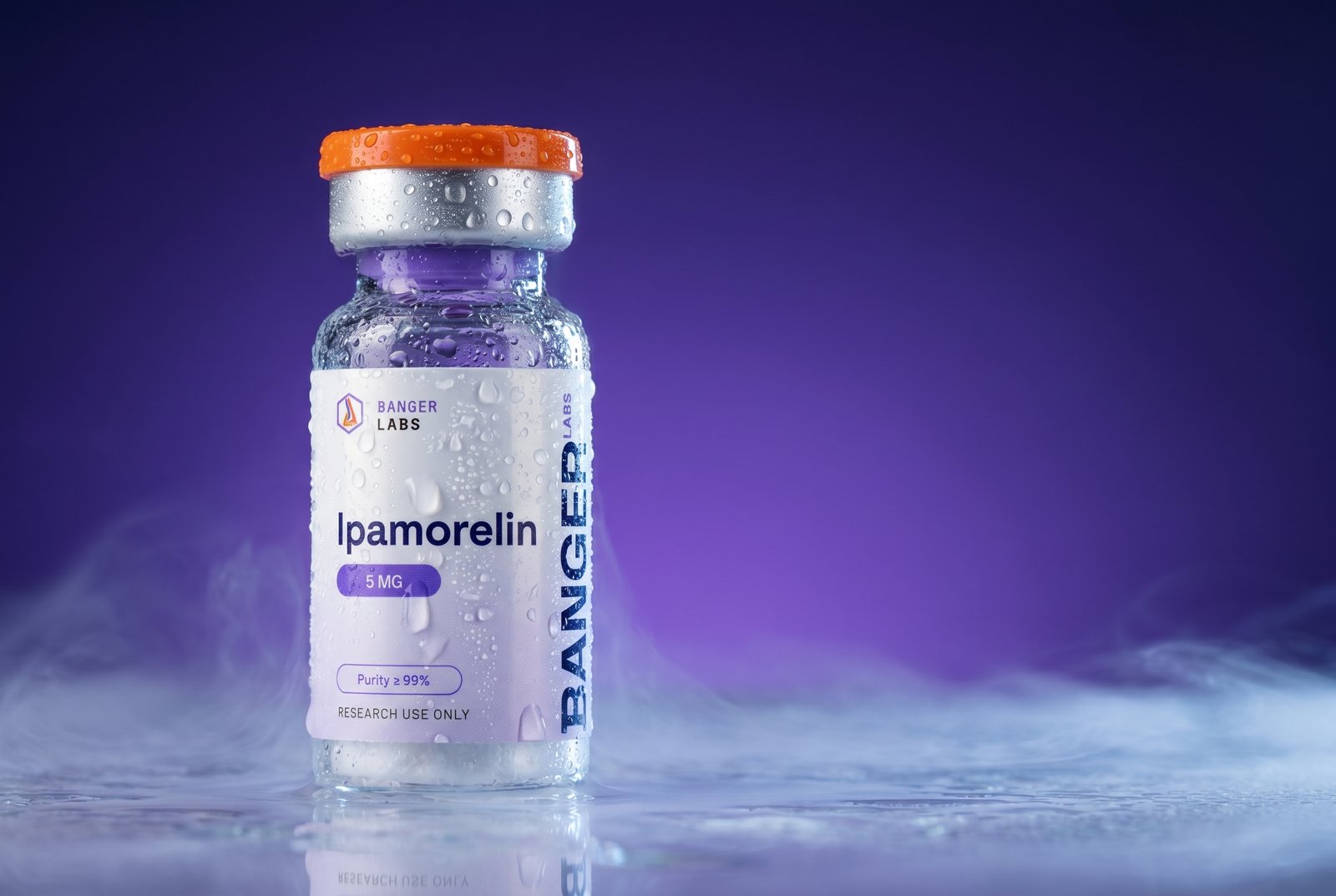
GHRP-2, GHRP-6, Ipamorelin, and Hexarelin are often grouped together as “GHRPs,” but in the preclinical literature they are four distinct molecules with meaningfully different selectivity profiles. All four act as growth-hormone secretagogues — synthetic agonists of the GHS-R1a (ghrelin) receptor that, in animal and in-vitro models, trigger pulsatile growth-hormone release through a pathway separate from the GHRH receptor. Where they diverge is in their “off-target” behavior: how strongly each one drives appetite signaling, cortisol and prolactin, and how potent each is at the receptor. This guide compares the four side by side using the established research literature, so researchers can map each peptide to the right experimental context. Everything below is presented for research use only — not for human consumption, and every mechanistic claim is attributed to preclinical, in-vitro, or animal sources.
The shared mechanism: ghrelin mimetics at the GHS-R1a receptor
All four peptides belong to the growth-hormone secretagogue (GHS) family, also called ghrelin mimetics. In preclinical models they bind GHS-R1a, the same G-protein-coupled receptor that endogenous ghrelin activates, and signal through the phospholipase-C / inositol-trisphosphate cascade. This is mechanistically distinct from the growth-hormone-releasing-hormone (GHRH) receptor that peptides like Sermorelin and CJC-1295 DAC target.
Because the two receptor systems are separate, the research literature has long described GHRPs and GHRH analogs as synergistic in cell and animal studies — co-administration produces a larger GH pulse than either class alone. That is the conceptual basis for why GHRP-class peptides are frequently studied alongside GHRH analogs rather than as direct substitutes for them.
The four peptides here are all short synthetic agonists of GHS-R1a, but they were developed in different programs and carry different secondary pharmacology. The selectivity differences — not the core GH-release mechanism — are what make a four-way comparison worthwhile.
Four-way comparison table
The table below summarizes how the four peptides are characterized across the research literature. The ‘selectivity’ column reflects whether a compound is described as acting cleanly through GH-release pathways or as carrying notable secondary signaling (appetite, cortisol, prolactin) in animal and in-vitro studies.
| Peptide | Class | Relative GHS-R1a potency (preclinical) | Appetite signaling | Cortisol / prolactin notes | Selectivity profile |
|---|---|---|---|---|---|
| GHRP-6 | Hexapeptide GHS | Moderate | Strong (classic hunger response in animal models) | Mild rises reported at higher doses | Least selective — pronounced appetite effect |
| GHRP-2 | Hexapeptide GHS | High | Moderate | Some cortisol/prolactin elevation reported in studies | Potent but with secondary signaling |
| Ipamorelin | Pentapeptide GHS | Moderate | Minimal | Negligible in preclinical reports | Most selective — ‘clean’ GH-release profile |
| Hexarelin | Hexapeptide GHS | High | Low-to-moderate | Cortisol/prolactin can rise; receptor desensitization noted with repeated exposure | Most potent; desensitization a research consideration |
View the individual product pages for GHRP-2, GHRP-6, Ipamorelin, and Hexarelin, or browse the full secretagogues research category.
GHRP-6: the appetite-driving prototype
GHRP-6 is one of the earliest synthetic GH secretagogues and is the molecule most strongly associated with appetite stimulation in animal studies. Because GHS-R1a is the native ghrelin receptor, and ghrelin is the body’s principal ‘hunger’ hormone in mammalian models, a strong GHS-R1a agonist like GHRP-6 reliably produces a pronounced feeding response in rodent research.
In the literature, that appetite signaling is treated as GHRP-6’s defining secondary characteristic. For researchers studying GH release without confounding feeding behavior, this makes GHRP-6 a poor choice; for those specifically modeling ghrelin-driven appetite pathways, it is a useful tool. Mild elevations in cortisol and prolactin have been reported at higher concentrations in some studies.
- Hexapeptide; classic early-generation GHS
- Strongest appetite response of the four in animal models
- Moderate GHS-R1a potency relative to GHRP-2 and Hexarelin
- Useful as a positive control for ghrelin-receptor appetite studies
GHRP-2: higher potency, more secondary signaling
GHRP-2 is generally characterized as more potent than GHRP-6 at driving GH release in preclinical models, while producing a more moderate appetite response. The trade-off the literature describes is that GHRP-2 tends to show more measurable elevation in cortisol and prolactin than the cleaner pentapeptide Ipamorelin.
This places GHRP-2 in a middle position: stronger at its primary action than GHRP-6, but not as selective as Ipamorelin. In comparative animal work it is frequently used precisely because it produces a robust, reproducible GH pulse, which is valuable when the GH signal itself is the variable of interest.
Across the GHRP series, potency at the secretagogue receptor and the magnitude of cortisol/prolactin co-secretion tend to track together — a recurring theme in the preclinical secretagogue literature.
Ipamorelin: the selectivity benchmark
Ipamorelin is a pentapeptide and is the compound most often described as a selective GH secretagogue. In the foundational pharmacology, it stimulates GH release through GHS-R1a comparably to other GHRPs at effective concentrations, but does so with minimal effect on appetite, cortisol, or prolactin in animal models — which is why it is repeatedly used as the ‘clean’ reference point in this family.
That selectivity is the main reason Ipamorelin is so commonly paired with GHRH analogs in research designs. The classic comparison is Ipamorelin vs CJC-1295 — a GHS plus a GHRH analog — where the appeal is GH release with as few confounding secondary signals as possible.
Hexarelin: highest potency, desensitization caveat
Hexarelin is among the most potent GHS-R1a agonists of the group in preclinical assays. The recurring research note that distinguishes it is receptor desensitization: repeated or sustained exposure in animal and cell models has been associated with attenuated GH responses over time, a phenomenon studied more with Hexarelin than with the other three.
Hexarelin has also been investigated for receptor interactions beyond GHS-R1a in cardiovascular tissue models — for example, binding at the CD36 scavenger receptor in some preclinical work — which broadens its experimental interest but also sets it apart from the more narrowly GH-focused peptides. As with GHRP-2, cortisol and prolactin elevations have been reported.
- Highest GHS-R1a potency of the four in many preclinical assays
- Desensitization with repeated exposure is a documented research consideration
- Investigated for additional (e.g., CD36) receptor interactions in animal tissue models
- Cortisol/prolactin co-secretion noted, similar to GHRP-2
How researchers map peptide to experiment
Matching profile to research question
- Studying GH release with minimal confounds — Ipamorelin is the selectivity benchmark, which is why it anchors clean GH-axis designs.
- Modeling ghrelin-driven appetite — GHRP-6’s strong feeding response makes it the natural tool, often as a positive control.
- Wanting a robust, high-potency GH pulse — GHRP-2 and Hexarelin are characterized as more potent, with the understanding that secondary signaling (and, for Hexarelin, desensitization) becomes part of the experimental picture.
- Pairing with a GHRH analog — any GHS can be studied alongside GHRH-receptor peptides, but the more selective the GHS, the cleaner the attribution.
Before any work begins, verifying identity and purity matters. See how to read a peptide COA and the reconstitution & storage guide for handling these lyophilized peptides in a laboratory setting.
Common questions
What is the core difference between GHRPs and GHRH analogs like CJC-1295 or Sermorelin?
They act on different receptors. GHRP-2, GHRP-6, Ipamorelin, and Hexarelin are ghrelin mimetics that agonize the GHS-R1a (secretagogue) receptor, while CJC-1295 and Sermorelin act on the GHRH receptor. In preclinical studies the two classes are described as synergistic, which is why they are often researched together rather than as substitutes.
Which of these four is considered the most selective?
Ipamorelin. In the foundational pharmacology it stimulates GH release through GHS-R1a while showing minimal effect on appetite, cortisol, and prolactin in animal models. That clean profile makes it the family’s reference compound for studies where attributing effects specifically to the GH axis is important. This is a research characterization, not human dosing guidance.
Why does GHRP-6 cause such a strong appetite response in animal studies?
GHS-R1a is the native receptor for ghrelin, the principal hunger hormone in mammalian models. GHRP-6 is a strong agonist at that receptor, so it reproduces ghrelin’s feeding response robustly in rodent research. That property makes it useful as a positive control for appetite-pathway studies and a poor choice when researchers want to isolate GH release alone.
What is the desensitization concern with Hexarelin?
Hexarelin is among the most potent GHS-R1a agonists of the group, but repeated or sustained exposure in animal and cell models has been associated with attenuated GH responses over time. Receptor desensitization is studied more prominently with Hexarelin than with the other three peptides, which is a relevant consideration in research design.
Are these peptides safe to take?
These materials are sold strictly for laboratory research use only and are not for human consumption. Banger Labs does not provide human dosing protocols or therapeutic guidance. All mechanistic descriptions in this guide are drawn from preclinical, in-vitro, and animal literature. See our research disclaimer for full terms.
Related research reading
References
- Bowers CY. Growth hormone-releasing peptide (GHRP). Cellular and Molecular Life Sciences. Review of the GHRP secretagogue family and GHS-R1a mechanism.
- Raun K, et al. Ipamorelin, the first selective growth hormone secretagogue. European Journal of Endocrinology, 1998. Foundational pharmacology describing Ipamorelin’s selectivity for GH release with minimal cortisol/prolactin/appetite effects.
- Howard AD, et al. A receptor in pituitary and hypothalamus that functions in growth hormone release (GHS-R). Science, 1996. Identification and characterization of the growth-hormone-secretagogue receptor (GHS-R1a).
- GHS-R1a / ghrelin receptor entry, NCBI Gene and PubChem — authoritative receptor and compound reference: https://www.ncbi.nlm.nih.gov/
Banger Labs supplies materials for laboratory and research use only. Not for human consumption. Not intended to diagnose, treat, cure, or prevent any disease. Statements have not been evaluated by the FDA.
Shop research peptides
Research-grade, ≥ 99% HPLC standard, COA per batch:
- BPC-157 vs TB-500: Research Comparison →
- CJC-1295 vs Ipamorelin: Research Comparison →
- Sermorelin vs CJC-1295 vs Tesamorelin: GHRH Analog Research Comparison →
Browse the full Research Library →
For research use only. Not for human or veterinary use. Not a drug, food, or cosmetic.