By the Banger Labs Research Team · Updated June 2026
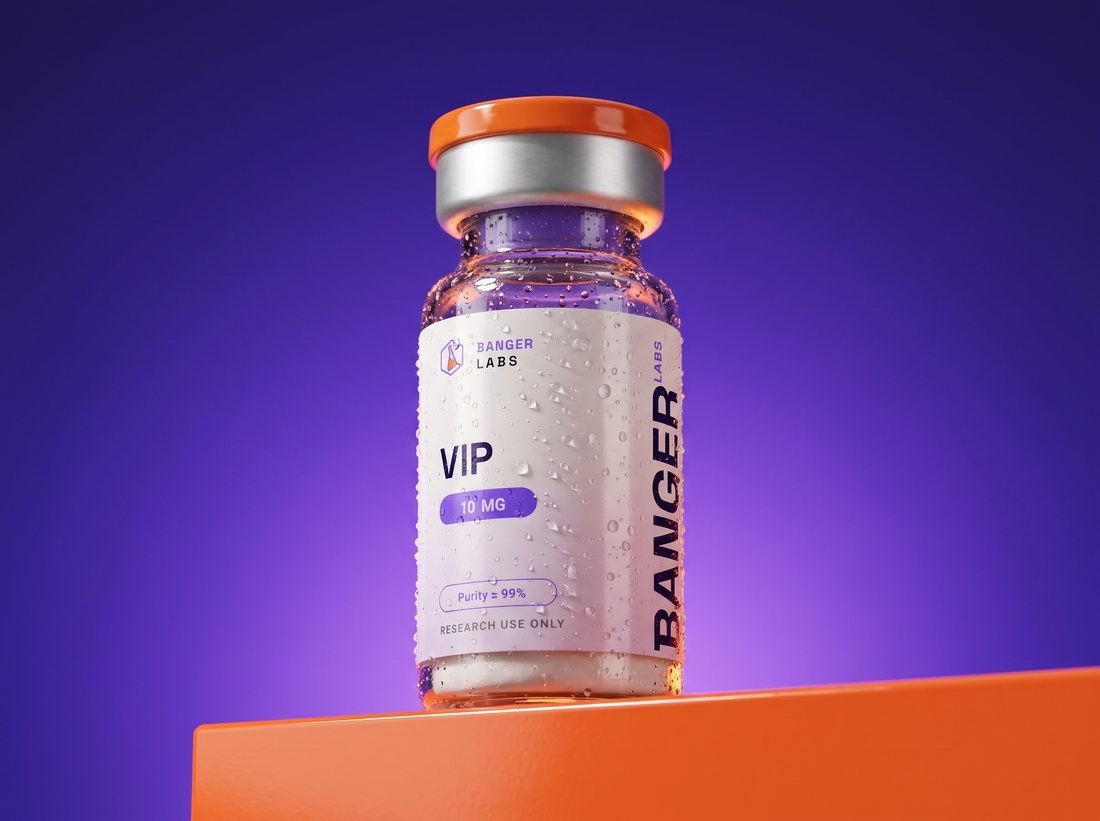
What is VIP?
VIP is a 28-residue peptide first isolated from intestinal tissue and is a member of the secretin/glucagon peptide superfamily, sharing sequence homology with secretin, PHI, and glucagon. Structural modeling describes a central alpha-helix (approximately residues 5-24) flanked by more flexible N- and C-terminal regions. It is endogenously expressed across many vertebrate tissues including the gut, pancreas, and central nervous system regions such as the cortex and the suprachiasmatic nucleus of the hypothalamus.
How VIP is studied
In preclinical and biochemical research, VIP acts as an agonist at two class B1 (secretin-family) G-protein-coupled receptors, VPAC1 and VPAC2, which it shares with the related peptide PACAP (PACAP additionally binds the PAC1 receptor). Receptor activation is coupled primarily to the stimulatory G protein (Gs), which activates adenylate cyclase and raises intracellular cAMP. Alanine-scanning and chimeric-receptor studies have mapped specific peptide residues and receptor domains (the N-terminal ectodomain and extracellular loops) that govern binding and subtype selectivity.
Research areas
- Studied in research models of smooth-muscle and vascular tone (vasodilation) and gastrointestinal/secretory physiology
- Investigated in neuroscience research, including neuroprotection and developmental neurobiology models
- Used as a tool ligand to probe VPAC1/VPAC2 receptor pharmacology and Gs/cAMP signaling
- Examined in immunology/inflammation research models (e.g., experimental colitis) for receptor-mediated signaling
- Studied in circadian-biology research given expression in the suprachiasmatic nucleus
These describe laboratory/preclinical research only. No therapeutic, medical, or efficacy claims are made.
VIP specifications
Handling & quality
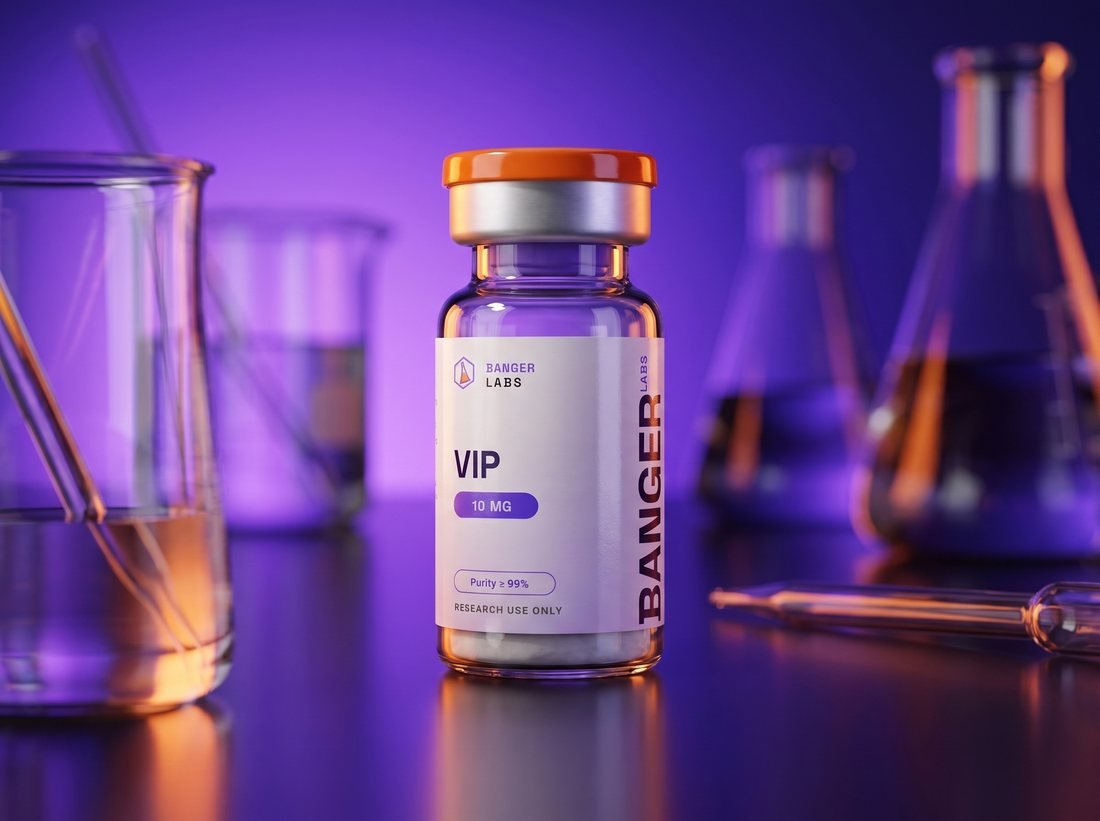
VIP is held to a ≥ 99% HPLC purity standard with a Certificate of Analysis available per batch. Reconstitute with bacteriostatic water and store refrigerated; handle strictly for research. See reconstitution & storage.
Frequently asked questions
What is VIP?
VIP is a 28-residue peptide first isolated from intestinal tissue and is a member of the secretin/glucagon peptide superfamily, sharing sequence homology with secretin, PHI, and glucagon. Structural modeling describes a central alpha-helix (approximately residues 5-24) flanked by more flexible N- and C-terminal regions. It is endogenously expressed across many vertebrate tissues including the gut, pancreas, and central nervous system regions such as the cortex and the suprachiasmatic nucleus of the hypothalamus.
Is VIP research use only?
Yes. VIP is supplied strictly for laboratory research — not for human or veterinary use, and not as a drug, food, or supplement.
Does Banger Labs provide a COA for VIP?
Yes — a Certificate of Analysis (HPLC purity + mass-spec identity) is available per batch on request. See the COA Library.
References
- VPAC receptors: structure, molecular pharmacology and interaction with accessory proteins — British Journal of Pharmacology (PMC)
- Therapeutic potential of vasoactive intestinal peptide and its receptors in neurological disorders — CNS Neurol Disord Drug Targets (PubMed)
- Identification of key residues for interaction of vasoactive intestinal peptide with human VPAC1 and VPAC2 receptors and development of a highly selective VPAC1 receptor agonist — J Biol Chem (PubMed)
- Vasoactive Intestinal Polypeptide or VIP — Pancreapedia
Sources are provided for scientific reference and describe laboratory/preclinical research; they do not constitute medical advice or efficacy claims.
Shop VIP & related research peptides
By the Banger Labs Research Team. For research use only. Not for human or veterinary use. Not a drug, food, or cosmetic. Educational information, not medical advice.