By the Banger Labs Research Team · Updated June 2026

What is MOTS-c?
MOTS-c (Mitochondrial Open reading frame of the Twelve S rRNA type-c) is a small peptide of 16 amino acids encoded by a short open reading frame within the mitochondrial 12S rRNA gene region, first described in the scientific literature in 2015. It belongs to the family of mitochondrial-derived peptides (MDPs). It is presented here solely as a research chemical for laboratory investigation, with no approved human use.

How MOTS-c is studied
In preclinical and cell-based research, MOTS-c is reported to act primarily through the folate-AICAR-AMPK axis: it is associated with inhibition of the folate cycle and de novo purine biosynthesis, leading to AICAR accumulation and activation of AMP-activated protein kinase (AMPK). Research models also describe MOTS-c translocating from the mitochondria to the nucleus under metabolic stress, where it has been studied in relation to stress-responsive and antioxidant (e.g., Nrf2-associated) gene expression. These are research-context mechanisms only and do not constitute therapeutic claims.

Research areas
- Studied in research models of cellular energy metabolism and AMPK signaling
- Investigated in preclinical models of metabolic homeostasis and insulin signaling
- Examined in research contexts of skeletal muscle physiology and exercise/metabolic stress responses
- Studied in laboratory models of inflammation and oxidative-stress (Nrf2-associated) pathways
- Investigated in preclinical aging and age-related physiological research
These describe laboratory/preclinical research only. No therapeutic, medical, or efficacy claims are made.

MOTS-c specifications
Handling & quality
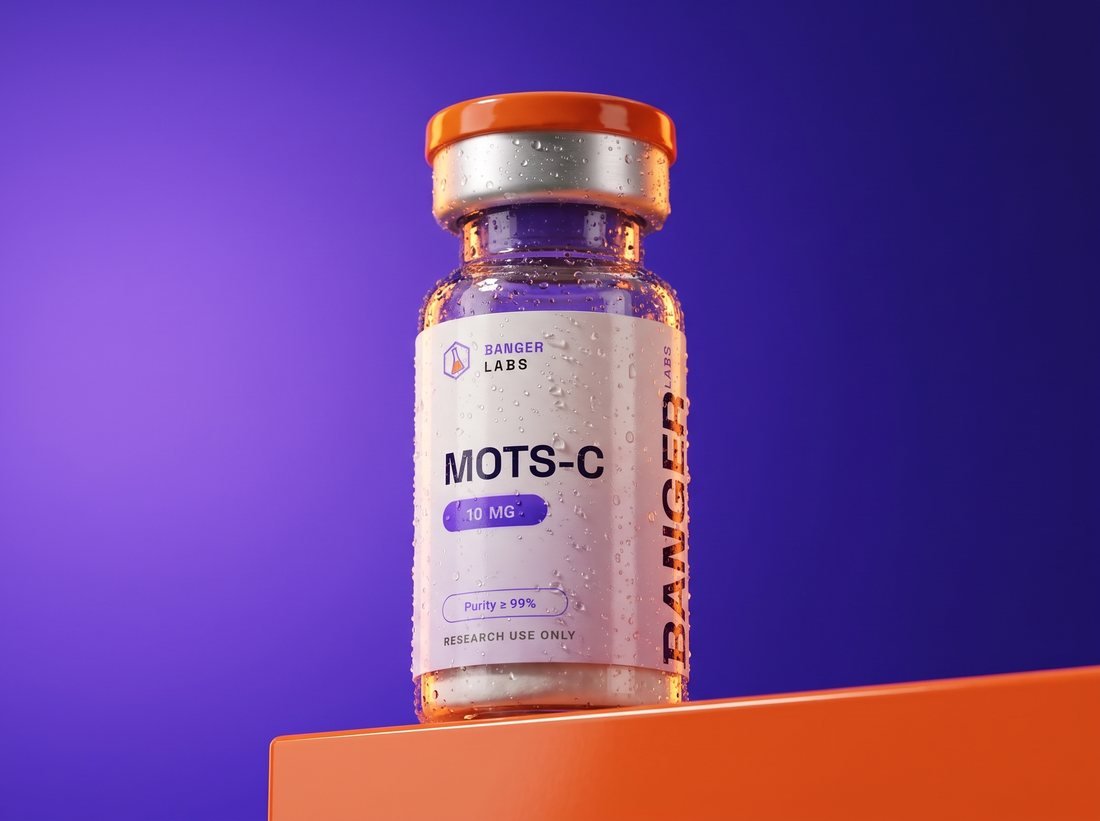
MOTS-c is held to a ≥ 99% HPLC purity standard with a Certificate of Analysis available per batch. Reconstitute with bacteriostatic water and store refrigerated; handle strictly for research. See reconstitution & storage.
Frequently asked questions
What is MOTS-c?
MOTS-c (Mitochondrial Open reading frame of the Twelve S rRNA type-c) is a small peptide of 16 amino acids encoded by a short open reading frame within the mitochondrial 12S rRNA gene region, first described in the scientific literature in 2015. It belongs to the family of mitochondrial-derived peptides (MDPs). It is presented here solely as a research chemical for laboratory investigation, with no approved human use.
Is MOTS-c research use only?
Yes. MOTS-c is supplied strictly for laboratory research — not for human or veterinary use, and not as a drug, food, or supplement.
Does Banger Labs provide a COA for MOTS-c?
Yes — a Certificate of Analysis (HPLC purity + mass-spec identity) is available per batch on request. See the COA Library.
References
- The Mitochondrial-Derived Peptide MOTS-c Promotes Metabolic Homeostasis and Reduces Obesity and Insulin Resistance — Cell Metabolism (Lee et al., 2015; PubMed PMID 25738459)
- Mitochondria-derived peptide MOTS-c: effects and mechanisms related to stress, metabolism and aging — Journal of Translational Medicine, 2023 (PMC9854231)
- The Mitochondrial-Derived Peptide MOTS-c Alleviates Radiation Pneumonitis via an Nrf2-Dependent Mechanism — PMC11117534
- Mitochondrial-Encoded Peptide MOTS-c, Diabetes, and Aging-Related Diseases — Diabetes & Metabolism Journal, 2023; 47(3):315-324
Sources are provided for scientific reference and describe laboratory/preclinical research; they do not constitute medical advice or efficacy claims.
Shop MOTS-c & related research peptides









By the Banger Labs Research Team. For research use only. Not for human or veterinary use. Not a drug, food, or cosmetic. Educational information, not medical advice.