By the Banger Labs Research Team · Updated June 2026
What is LL-37?
LL-37 is the only cathelicidin-family antimicrobial peptide identified in humans. It is the mature C-terminal 37-amino-acid peptide (sequence LLGDFFRKSKEKIGKEFKRIVQRIKDFLRNLVPRTES, named for its two N-terminal leucines) released from the precursor protein hCAP18/CAP-18, which is encoded by the CAMP gene on chromosome 3 and processed by extracellular proteolytic cleavage (e.g., proteinase 3). It is studied in research and preclinical contexts as a cationic, amphipathic host-defense peptide.
How LL-37 is studied
In research models, LL-37 acts as a cationic amphipathic peptide that interacts with and disrupts microbial membranes and binds/neutralizes bacterial endotoxin (LPS). Beyond direct membrane activity, it is reported to signal through host receptors including formyl peptide receptor 2 (FPR2/FPRL1), P2X7, EGFR, and several scavenger receptors, engaging downstream PI3K/Akt and MAPK/Erk pathways that are studied in connection with chemotaxis and immune modulation.
Research areas
- Investigated in preclinical models of innate antimicrobial activity against bacteria, with reported antiviral and antifungal activity in laboratory studies
- Studied as an immunomodulatory host-defense peptide, including endotoxin (LPS) binding and chemotaxis of immune cells in research settings
- Examined in research on wound-closure and tissue-repair signaling pathways
- Studied for angiogenesis-related signaling in laboratory models
- Explored in basic oncology research as a peptide of interest (mechanistic/cell-based studies only)
These describe laboratory/preclinical research only. No therapeutic, medical, or efficacy claims are made.
LL-37 specifications
Handling & quality
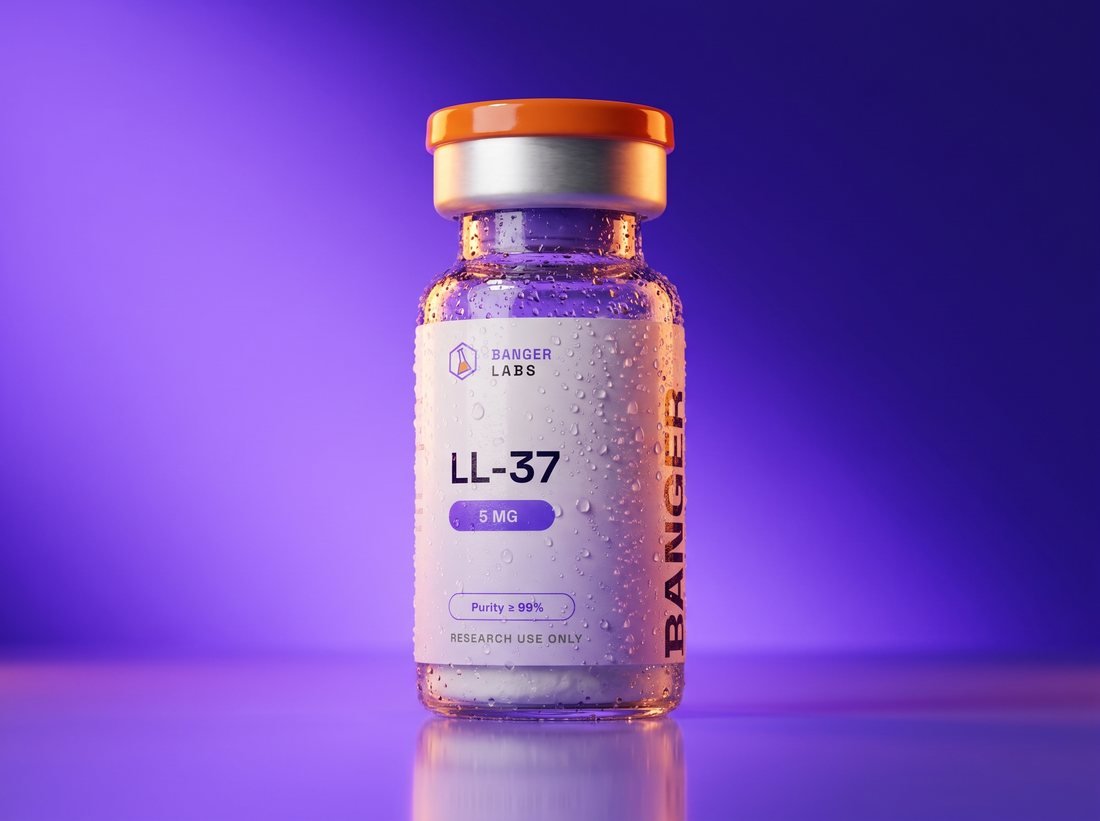
LL-37 is held to a ≥ 99% HPLC purity standard with a Certificate of Analysis available per batch. Reconstitute with bacteriostatic water and store refrigerated; handle strictly for research. See reconstitution & storage.
Frequently asked questions
What is LL-37?
LL-37 is the only cathelicidin-family antimicrobial peptide identified in humans. It is the mature C-terminal 37-amino-acid peptide (sequence LLGDFFRKSKEKIGKEFKRIVQRIKDFLRNLVPRTES, named for its two N-terminal leucines) released from the precursor protein hCAP18/CAP-18, which is encoded by the CAMP gene on chromosome 3 and processed by extracellular proteolytic cleavage (e.g., proteinase 3). It is studied in research and preclinical contexts as a cationic, amphipathic host-defense peptide.
Is LL-37 research use only?
Yes. LL-37 is supplied strictly for laboratory research — not for human or veterinary use, and not as a drug, food, or supplement.
Does Banger Labs provide a COA for LL-37?
Yes — a Certificate of Analysis (HPLC purity + mass-spec identity) is available per batch on request. See the COA Library.
References
- Antimicrobial Peptides of the Cathelicidin Family: Focus on LL-37 and Its Modifications — International Journal of Molecular Sciences (PubMed, 2025 review)
- The Human Cathelicidin Antimicrobial Peptide LL-37 and Mimics are Potential Anticancer Drugs — Frontiers in Oncology, 2015 (PMC)
- The Antimicrobial Peptide Cathelicidin Exerts Immunomodulatory Effects via Scavenger Receptors — International Journal of Molecular Sciences, 2023 (PMC)
- Human antimicrobial/host defense peptide LL-37 may prevent the spread of a local infection through multiple mechanisms: an update — Inflammation Research, 2025 review (PMC open access)
Sources are provided for scientific reference and describe laboratory/preclinical research; they do not constitute medical advice or efficacy claims.
Shop LL-37 & related research peptides
By the Banger Labs Research Team. For research use only. Not for human or veterinary use. Not a drug, food, or cosmetic. Educational information, not medical advice.