By the Banger Labs Research Team · Updated June 2026
What is AHK-Cu?
AHK-Cu is a laboratory-synthesized tripeptide composed of the amino acid sequence alanine-histidine-lysine (Ala-His-Lys) coordinated to a divalent copper ion (Cu2+), with the molecular formula C15H23CuN6O4- (PubChem CID 169450582; CAS 682809-81-0). It is a structural analog of the naturally occurring copper-binding peptide GHK-Cu, differing by an alanine-for-glycine substitution at the N-terminus, and is typically described as a blue-to-purple copper-peptide powder. It is handled as a research compound, not as an approved therapeutic.
How AHK-Cu is studied
As a copper-binding tripeptide, AHK-Cu coordinates Cu2+ and is studied as a model for copper-peptide coordination chemistry and copper-dependent cellular signaling in in vitro and ex vivo systems. In a 2007 in vitro/ex vivo study (Pyo et al.), AHK-Cu was reported to stimulate cultured dermal papilla cell proliferation, raise the Bcl-2/Bax ratio, reduce cleaved caspase-3 and PARP markers, increase vascular endothelial growth factor (VEGF) production, and decrease TGF-beta1 secretion by dermal fibroblasts. These are laboratory observations only and do not establish any clinical effect in humans.
Research areas
- Studied in in vitro cultured dermal papilla cell models and ex vivo human hair-follicle organ-culture systems
- Investigated in research on copper-peptide coordination chemistry and metal-peptide interactions
- Examined in laboratory studies of apoptosis-related markers (Bcl-2/Bax ratio, cleaved caspase-3, PARP)
- Explored as a research tool in studies of growth-factor expression (VEGF, TGF-beta1) by cultured cells
- Used in structure-activity research as a synthetic analog of the GHK-Cu copper tripeptide
These describe laboratory/preclinical research only. No therapeutic, medical, or efficacy claims are made.
AHK-Cu specifications
Handling & quality
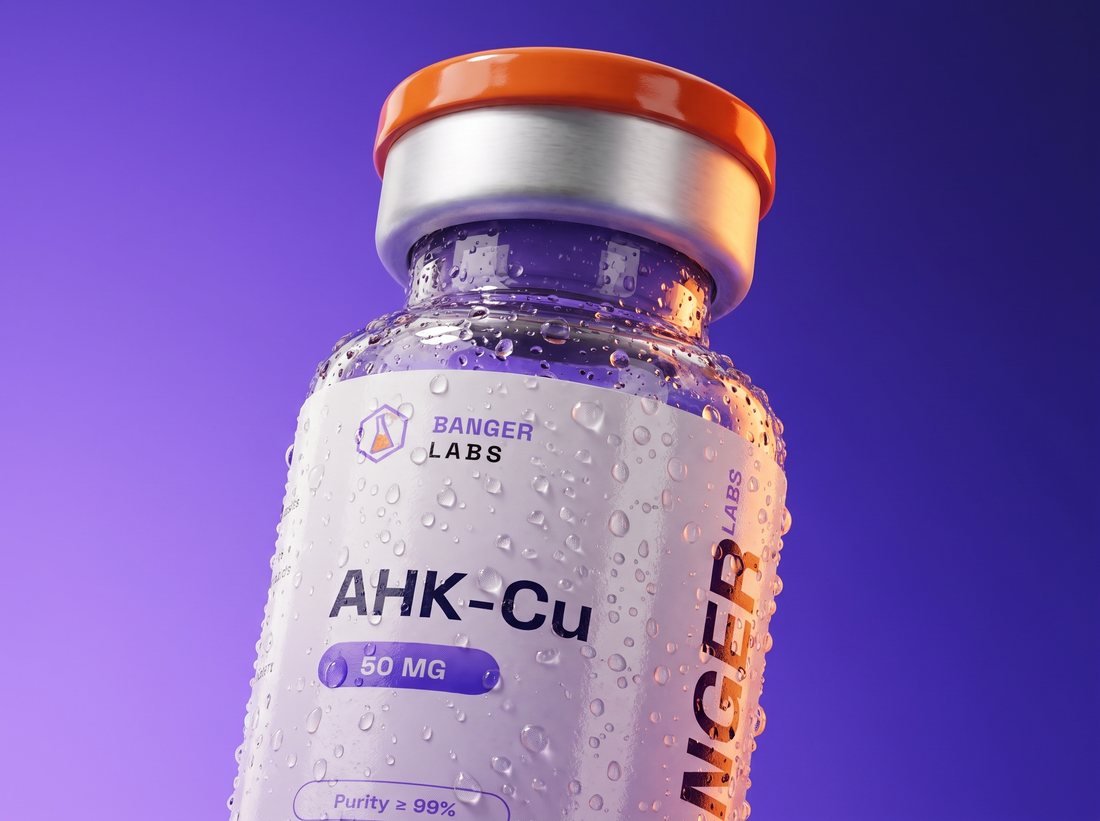
AHK-Cu is held to a ≥ 99% HPLC purity standard with a Certificate of Analysis available per batch. Reconstitute with bacteriostatic water and store refrigerated; handle strictly for research. See reconstitution & storage.
Frequently asked questions
What is AHK-Cu?
AHK-Cu is a laboratory-synthesized tripeptide composed of the amino acid sequence alanine-histidine-lysine (Ala-His-Lys) coordinated to a divalent copper ion (Cu2+), with the molecular formula C15H23CuN6O4- (PubChem CID 169450582; CAS 682809-81-0). It is a structural analog of the naturally occurring copper-binding peptide GHK-Cu, differing by an alanine-for-glycine substitution at the N-terminus, and is typically described as a blue-to-purple copper-peptide powder. It is handled as a research compound, not as an approved therapeutic.
Is AHK-Cu research use only?
Yes. AHK-Cu is supplied strictly for laboratory research — not for human or veterinary use, and not as a drug, food, or supplement.
Does Banger Labs provide a COA for AHK-Cu?
Yes — a Certificate of Analysis (HPLC purity + mass-spec identity) is available per batch on request. See the COA Library.
References
- The effect of tripeptide-copper complex on human hair growth in vitro (Pyo HK et al., Arch Pharm Res, 2007) — PubMed / Archives of Pharmaceutical Research
- Copper tripeptide-3 (AHK-Cu), C15H23CuN6O4-, CID 169450582 — PubChem (NIH/NLM)
Sources are provided for scientific reference and describe laboratory/preclinical research; they do not constitute medical advice or efficacy claims.
Shop AHK-Cu & related research peptides
By the Banger Labs Research Team. For research use only. Not for human or veterinary use. Not a drug, food, or cosmetic. Educational information, not medical advice.