By the Banger Labs Research Team · Updated June 2026
What is GHRP-6?
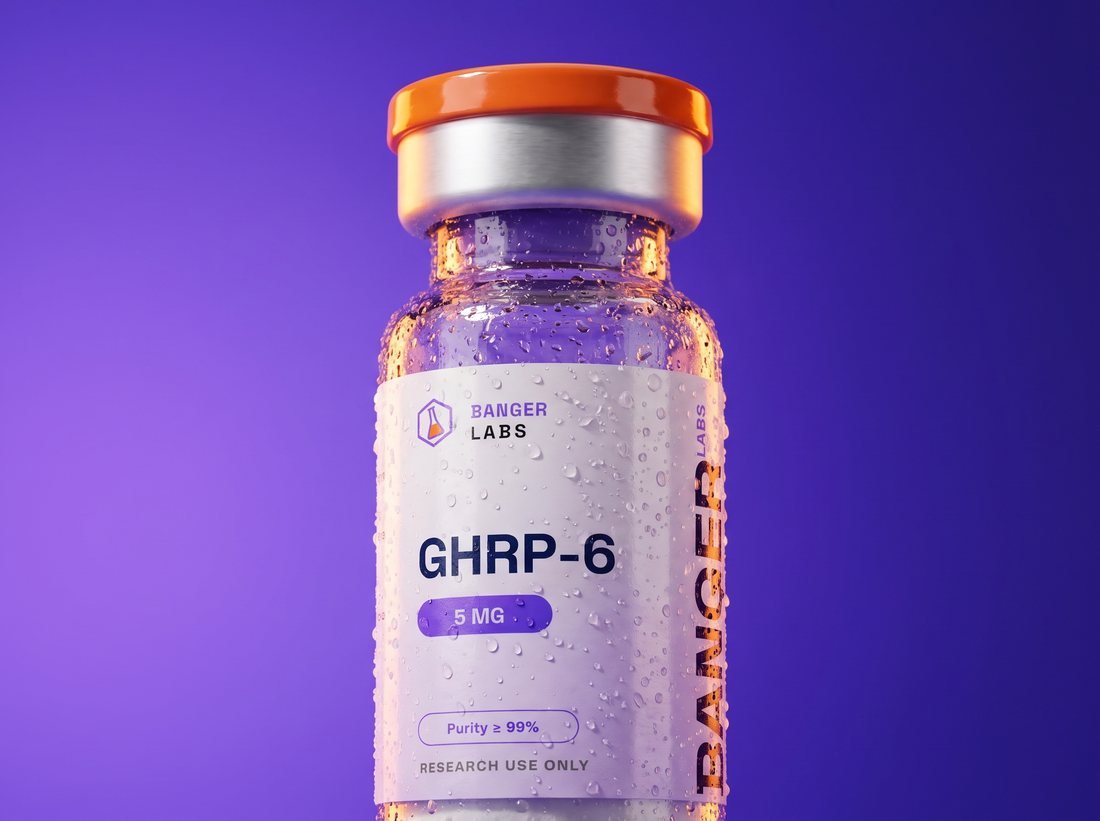
GHRP-6 is a synthetic hexapeptide with the amino acid sequence His-D-Trp-Ala-Trp-D-Phe-Lys-NH2, characterized in work by Bowers and colleagues (Endocrinology, 1984) describing a synthetic hexapeptide shown to release growth hormone from the pituitary in vitro and in vivo through a mechanism distinct from growth hormone-releasing hormone (GHRH). It belongs to the growth hormone secretagogue (GHS) class and is regarded as a prototype of the GHRP family. It is supplied and handled as a research chemical for in vitro and non-human laboratory investigation only.
How GHRP-6 is studied
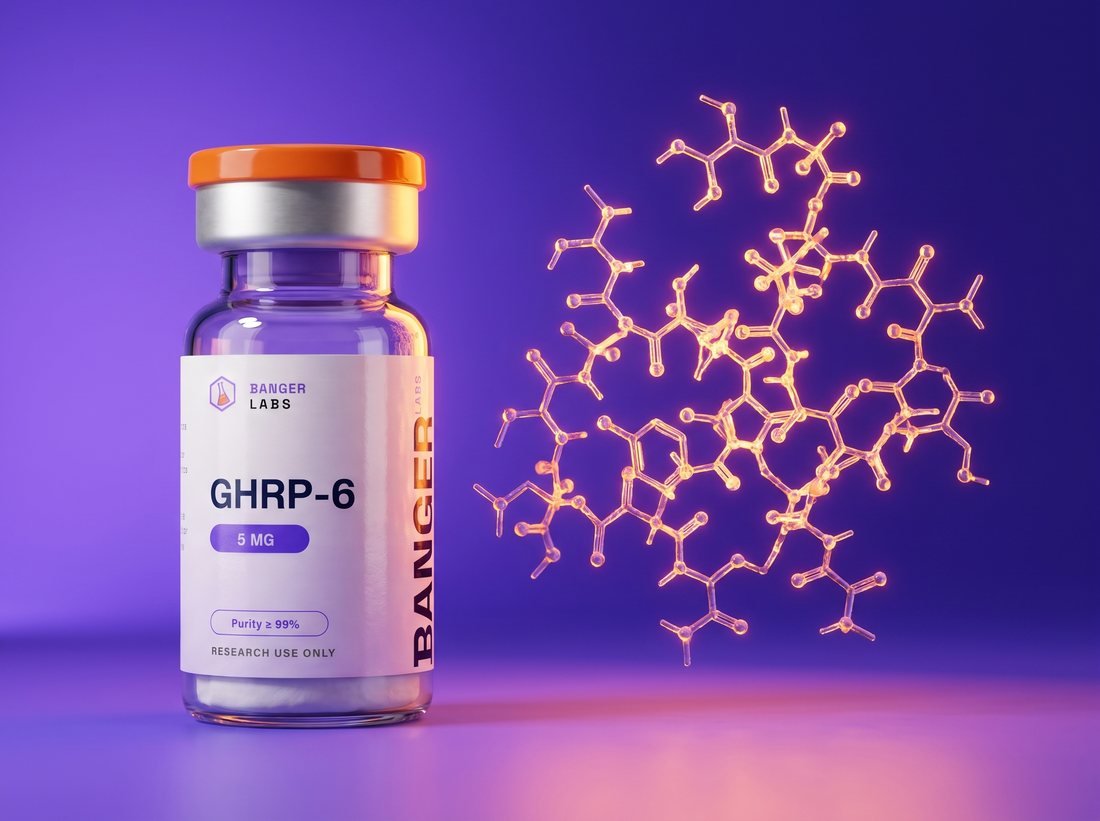
In research models GHRP-6 acts as an agonist at the growth hormone secretagogue receptor type 1a (GHS-R1a), later identified as the ghrelin receptor, making it a functional ghrelin mimetic. Receptor activation on pituitary somatotrophs is associated in the literature with intracellular signaling (including increased intracellular calcium) linked to pulsatile growth hormone release, and hypothalamic GHS-R1a activation is studied in food-intake/appetite signaling models. Some preclinical reports also describe interaction with the scavenger receptor CD36 and growth-hormone-independent signaling pathways.
Research areas
- Studied as a pharmacological tool for probing GHS-R1a / ghrelin-receptor signaling in vitro
- Investigated in preclinical models of growth hormone secretagogue pharmacology and pituitary somatotroph function
- Used in research on hypothalamic appetite/food-intake signaling pathways (e.g., arcuate-nucleus neurons)
- Examined in animal/cell cytoprotection research models (e.g., myocardial ischemia-reperfusion injury)
- Serves as a historical reference scaffold from which later GHS research peptides were derived
These describe laboratory/preclinical research only. No therapeutic, medical, or efficacy claims are made.
GHRP-6 specifications
Handling & quality
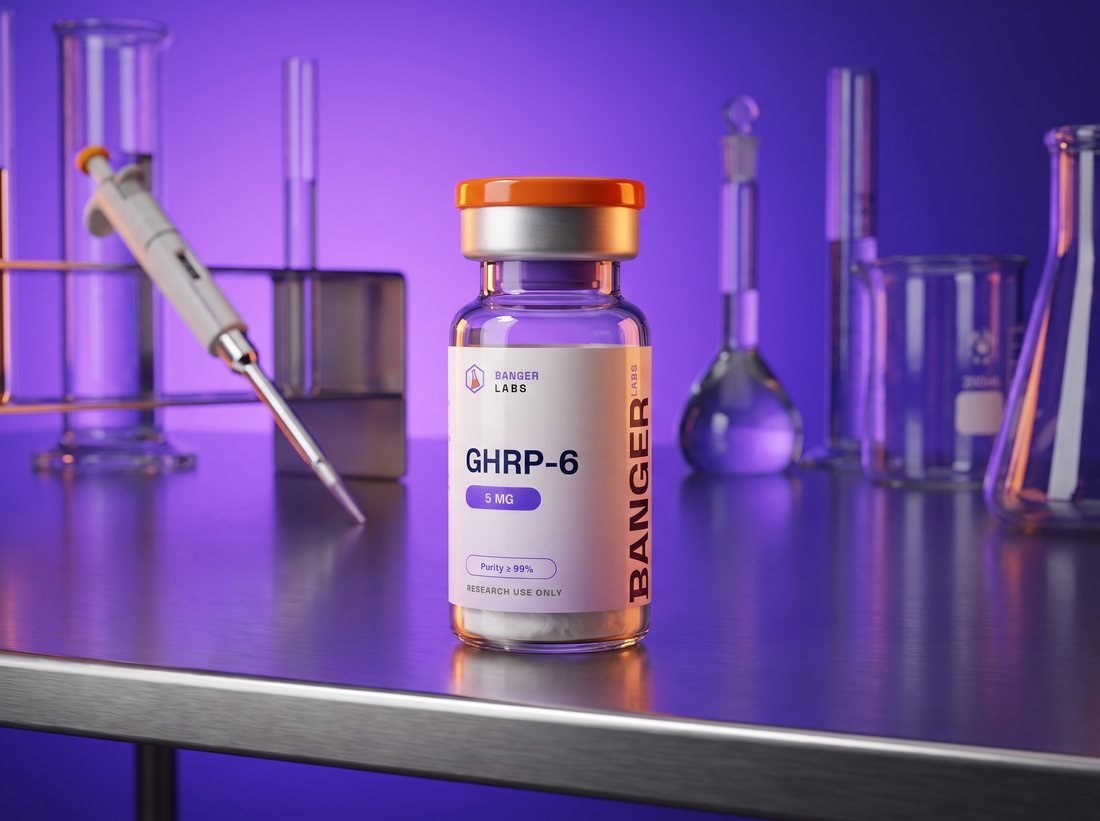
GHRP-6 is held to a ≥ 99% HPLC purity standard with a Certificate of Analysis available per batch. Reconstitute with bacteriostatic water and store refrigerated; handle strictly for research. See reconstitution & storage.
Frequently asked questions
What is GHRP-6?
GHRP-6 is a synthetic hexapeptide with the amino acid sequence His-D-Trp-Ala-Trp-D-Phe-Lys-NH2, characterized in work by Bowers and colleagues (Endocrinology, 1984) describing a synthetic hexapeptide shown to release growth hormone from the pituitary in vitro and in vivo through a mechanism distinct from growth hormone-releasing hormone (GHRH). It belongs to the growth hormone secretagogue (GHS) class and is regarded as a prototype of the GHRP family. It is supplied and handled as a research chemical for in vitro and non-human laboratory investigation only.
Is GHRP-6 research use only?
Yes. GHRP-6 is supplied strictly for laboratory research — not for human or veterinary use, and not as a drug, food, or supplement.
Does Banger Labs provide a COA for GHRP-6?
Yes — a Certificate of Analysis (HPLC purity + mass-spec identity) is available per batch on request. See the COA Library.
References
- On the in Vitro and in Vivo Activity of a New Synthetic Hexapeptide that Acts on the Pituitary to Specifically Release Growth Hormone (Bowers et al., Endocrinology 1984) — Endocrinology, 1984;114(5):1537-45, PMID 6714155
- Binding of a growth hormone releasing hexapeptide to specific hypothalamic and pituitary binding sites (Codd et al., Neuropharmacology 1989) — Neuropharmacology, 1989;28(10):1139-44, PMID 2812284
- Intranasal Delivery of a Ghrelin Mimetic Engages the Brain Ghrelin Signaling System in Mice — PubMed Central, PMC11795113
- Growth hormone releasing peptide-6 (GHRP-6) and other related secretagogue synthetic peptides: a mine of medical potentialities for unmet medical needs — Integrative Molecular Medicine (OAText) review article
Sources are provided for scientific reference and describe laboratory/preclinical research; they do not constitute medical advice or efficacy claims.
Shop GHRP-6 & related research peptides
By the Banger Labs Research Team. For research use only. Not for human or veterinary use. Not a drug, food, or cosmetic. Educational information, not medical advice.