By the Banger Labs Research Team · Updated June 2026
What is IGF-1 LR3?
IGF-1 LR3 (“Long R3 IGF-1”) is an engineered analog of native human IGF-1 that contains 83 amino acids versus the native 70. It carries an arginine substituted for glutamic acid at position 3 (“R3”) plus a 13-residue N-terminal extension, and is produced recombinantly. It is described in the research literature and used as a laboratory reference compound and a cell-culture supplement.
How IGF-1 LR3 is studied
In preclinical and in-vitro studies, IGF-1 LR3 acts as an agonist at the type-1 IGF receptor (IGF-1R), a receptor tyrosine kinase, with downstream signaling reported through the PI3K/Akt and MAPK/ERK pathways. Its defining feature in the literature is markedly reduced binding affinity for the IGF-binding proteins (IGFBPs) relative to native IGF-1, which has been characterized in competitive-binding and animal-model studies. This altered IGFBP interaction is the basis for the differing tissue and gene-expression responses observed between IGF-1 LR3 and native IGF-1 in research models.
Research areas
- Studied as a reference IGF-1R agonist in receptor-signaling and binding-characterization research
- Used as a supplement/reagent in mammalian cell-culture and recombinant-protein production research
- Investigated in animal models for effects on organ and tissue growth parameters and on circulating IGF/IGFBP concentrations (e.g., guinea pig, rat)
- Examined in in-vitro embryo development models for effects on cell number and IGFBP/IGF-receptor mRNA abundance (bovine embryos)
- Used to compare IGFBP-binding behavior of IGF-1 analogs versus native IGF-1 in clearance/pharmacokinetic research
These describe laboratory/preclinical research only. No therapeutic, medical, or efficacy claims are made.
IGF-1 LR3 specifications
Handling & quality
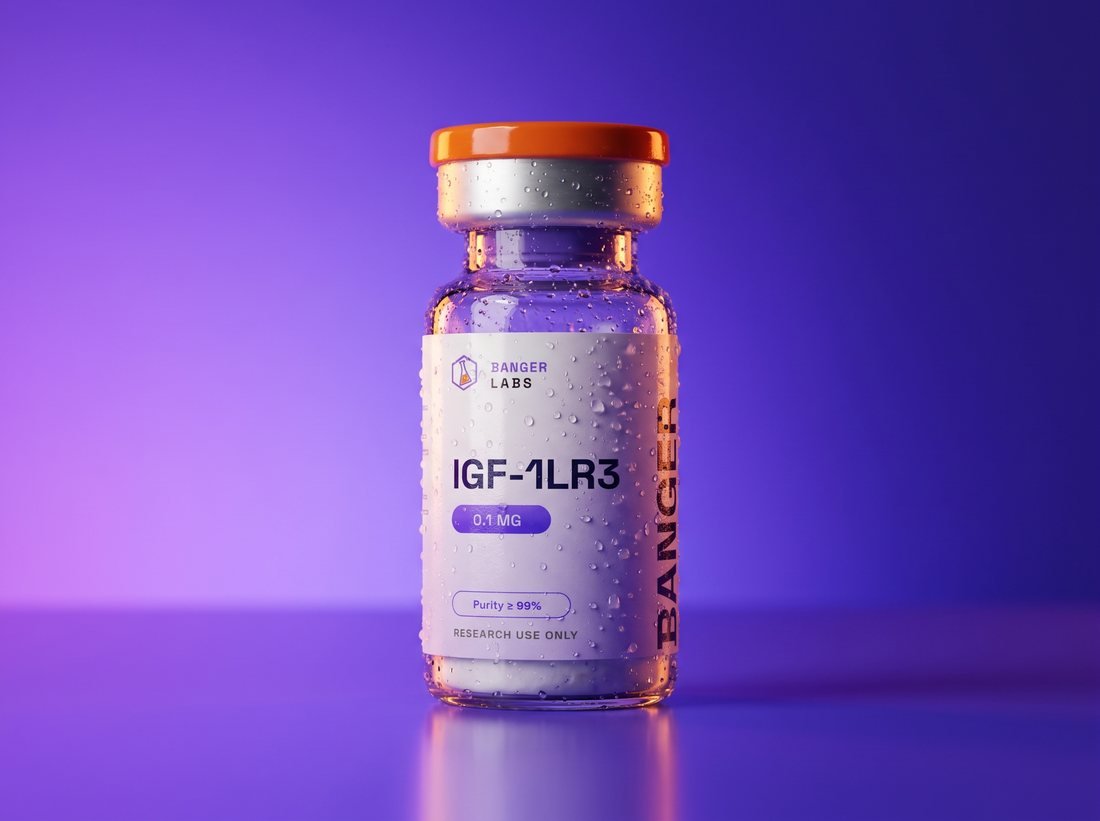
IGF-1 LR3 is held to a ≥ 99% HPLC purity standard with a Certificate of Analysis available per batch. Reconstitute with bacteriostatic water and store refrigerated; handle strictly for research. See reconstitution & storage.
Frequently asked questions
What is IGF-1 LR3?
IGF-1 LR3 (“Long R3 IGF-1”) is an engineered analog of native human IGF-1 that contains 83 amino acids versus the native 70. It carries an arginine substituted for glutamic acid at position 3 (“R3”) plus a 13-residue N-terminal extension, and is produced recombinantly. It is described in the research literature and used as a laboratory reference compound and a cell-culture supplement.
Is IGF-1 LR3 research use only?
Yes. IGF-1 LR3 is supplied strictly for laboratory research — not for human or veterinary use, and not as a drug, food, or supplement.
Does Banger Labs provide a COA for IGF-1 LR3?
Yes — a Certificate of Analysis (HPLC purity + mass-spec identity) is available per batch on request. See the COA Library.
References
- IGF-1 LR3 — Wikipedia (overview with cited primary references)
- Insulin-like growth factor I (IGF-I) and long R(3)IGF-I differently affect development and mRNA abundance for IGF-binding proteins and type I IGF receptors in in vitro produced bovine embryos — Endocrinology, 2001;142(3):1309-16 (PMID 11181549)
- Long R3 insulin-like growth factor-I (IGF-I) infusion stimulates organ growth but reduces plasma IGF-I, IGF-II and IGF binding protein concentrations in the guinea pig — Journal of Endocrinology, 1995;146(2):247-53 (PMID 7561636)
- Superior potency of infused IGF-I analogues which bind poorly to IGF-binding proteins is maintained when administered by injection — Journal of Endocrinology, 1996;150(1):77-84 (PMID 8708565)
Sources are provided for scientific reference and describe laboratory/preclinical research; they do not constitute medical advice or efficacy claims.
Shop IGF-1 LR3 & related research peptides
By the Banger Labs Research Team. For research use only. Not for human or veterinary use. Not a drug, food, or cosmetic. Educational information, not medical advice.