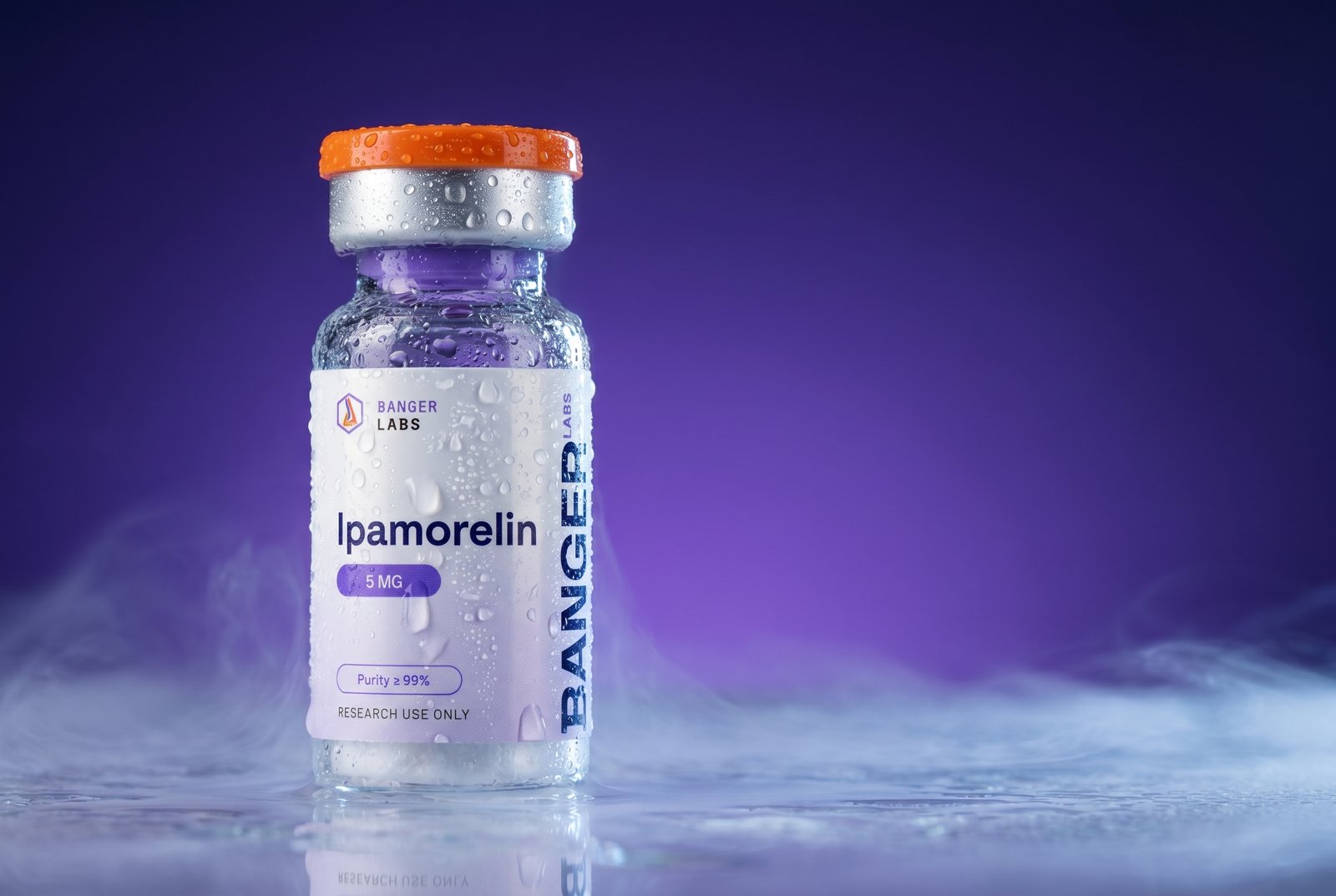
Lyophilized research peptides arrive as a small puck of powder at the bottom of a vial — useless at the bench until you have the right diluent, the right syringe, and a sane place to store the reconstituted material. Getting the supplies wrong is the single most common way a research workflow goes sideways: the wrong water shortens working life, the wrong syringe makes accurate volume handling miserable, and the wrong storage quietly degrades the compound you are trying to study. This guide covers what you actually need on the bench, why bacteriostatic water and sterile water are not interchangeable for every job, how to size needles and syringes for reconstitution, and what storage gear keeps a vial usable. Everything here is for research use only — not for human consumption.
What handling research peptides actually requires
Peptides ship lyophilized (freeze-dried) because the dry powder is far more stable in transit and storage than any solution. Before in-vitro or animal-model work, the powder has to be brought back into solution — reconstituted — with a compatible diluent. That single step is where most of your supply list comes from.
At a minimum, a functional research bench needs four things: a diluent to reconstitute the powder, a syringe and needle to add diluent and draw working volumes, alcohol prep pads to wipe stoppers and surfaces, and somewhere cold to keep the reconstituted vial. Everything else on a supply list is a refinement of those four basics.
- Diluent — bacteriostatic or sterile water (see the next section for which, and when)
- Syringes + needles — for adding diluent and for measured handling of the solution
- Alcohol prep pads — to clean the rubber stopper before every needle insertion
- Cold storage + labels — a reliable fridge/freezer, plus a way to date and identify each vial
If you want the full mechanical walkthrough of bringing a vial into solution, pair this guide with our peptide reconstitution and storage guide. This article is the shopping list; that one is the how-to. You can source most of the consumables below from the research supplies category.
Bacteriostatic water vs sterile water: the key distinction
The two most common diluents look identical in the vial, but they behave differently once a needle has been through the stopper. The deciding factor is whether the water contains a preservative.
Bacteriostatic water is water for injection with roughly 0.9% benzyl alcohol added as a bacteriostatic preservative. Benzyl alcohol inhibits the growth of many common bacteria, which means a vial can be entered multiple times over a period of days to weeks with a lower risk of microbial growth between draws. That makes it the practical default for a reconstituted research vial that will be sampled more than once.
Sterile water for injection contains no preservative — it is simply water that has been sterilized. It is appropriate for single-use scenarios or where a preservative would interfere with the experiment, but an opened, preservative-free vial offers no protection against contamination introduced on subsequent entries and is generally treated as single-entry.
| Property | Bacteriostatic water | Sterile water |
|---|---|---|
| Preservative | ~0.9% benzyl alcohol | None |
| Multi-entry suitability | Yes — preservative slows microbial growth | No — treat as single-use |
| Typical working life once opened | Often weeks (preservative-dependent) | Shorter; no protection after entry |
| Best for | Reconstituted vials sampled repeatedly | Single-use prep, or when benzyl alcohol must be avoided |
| Compatibility caveat | Benzyl alcohol can interfere with some sensitive assays | Inert — no additive to interfere |
For peptides with limited aqueous solubility, plain water of either type may not be enough — some compounds need a specified buffer, a trace of acetic acid, or a small fraction of an organic co-solvent. Always check the compound’s documentation, and confirm identity and content against the certificate of analysis. Our how to read a peptide COA guide explains what to look for, and peptide purity explained covers why purity figures change how a solution behaves.
Syringe and needle sizing for reconstitution
Two separate jobs need a syringe: adding diluent to the dry vial, and drawing measured working volumes afterward. They have different ideal tools, and trying to use one syringe for both is where accuracy suffers.
Gauge, length, and what the numbers mean
- Gauge (G) is needle diameter — and counterintuitively, a *higher* number is a *thinner* needle. A 30G needle is finer than a 25G.
- Length is given in inches (e.g., 1/2″, 5/8″, 1″). Shorter needles are fine for handling solution; longer needles reach the bottom of taller vials.
- Barrel volume is the syringe’s total capacity (e.g., 0.3 mL, 0.5 mL, 1 mL) and sets how finely the graduations are spaced.
Adding diluent
For pushing bacteriostatic or sterile water into the dry vial, a larger barrel (1 mL or more) and a slightly thicker needle (around 21–23G) move liquid quickly and let you direct the stream against the glass wall rather than blasting the powder, which helps avoid foaming and denaturation. Some researchers draw diluent with a larger syringe, then switch to a fine needle for everything afterward.
Drawing measured working volumes
For measured handling of the reconstituted solution, a small-barrel syringe with fine graduations gives the most precise reads. A 0.3 mL or 0.5 mL barrel resolves small volumes far better than a 1 mL barrel, because the same liquid is spread across more closely spaced markings. Fine-gauge needles (29–31G) pass through the stopper with minimal coring.
| Task | Suggested barrel | Suggested needle | Why |
|---|---|---|---|
| Add diluent to dry vial | 1 mL or larger | 21–23G, 1″ | Faster fluid transfer; reaches vial bottom; aim stream at glass wall |
| Draw measured working volume | 0.3–0.5 mL | 29–31G, 1/2″ | Finer graduations = better volume resolution; thin needle limits coring |
| General solution handling | 1 mL | 27–30G, 1/2″ | Versatile middle ground when keeping one syringe type |
Storage supplies that protect the vial
Reconstitution is only half the job; how you store the result decides how long the material stays usable. Peptides in solution are more fragile than the dry powder, and they degrade with heat, light, and freeze-thaw cycling.
- Refrigeration — most reconstituted peptide solutions are kept refrigerated (roughly 2–8 °C) for short-term working storage. A dedicated lab fridge avoids the temperature swings of a frequently opened shared unit.
- Freezer for long-term — the dry, lyophilized powder is typically stored frozen for long-term holding; repeated freeze-thaw of a solution should be minimized, so aliquoting before freezing is common practice.
- Amber vials or a light-blocking box — many peptides are light-sensitive, so keeping vials out of direct light protects them.
- Labels and a marker — date of reconstitution, compound, concentration, and diluent on every vial. This is the cheapest supply on the list and the one most often skipped.
Whether you bought powder that’s still sealed or a vial you’ve already opened changes the handling, and our lyophilized vs reconstituted peptides guide explains why the dry and dissolved forms have such different shelf lives. The short version: keep it cold, keep it dark, label it, and don’t thaw-and-refreeze repeatedly.
A complete starter supply list
If you’re setting up a bench from scratch for research handling, this is the practical kit. Quantities depend on how many vials you process, but the categories don’t change.
- Diluent — bacteriostatic water as the multi-entry default; sterile water on hand for single-use or additive-sensitive work
- Two syringe types — a larger barrel for adding diluent, a 0.3–0.5 mL barrel with fine graduations for measured handling
- Needles — a thicker gauge (21–23G) for transfer, fine gauge (29–31G) for stopper entry
- Alcohol prep pads — wipe the stopper before every entry
- Cold storage — fridge for working solution, freezer for long-term powder
- Light protection — amber vials or an opaque storage box
- Labels + marker — compound, concentration, diluent, and date on each vial
Pair the kit with the right compounds from the catalog. Growth-hormone-secretagogue research peptides such as ipamorelin, CJC-1295 (no DAC), and sermorelin acetate sit in the secretagogues category; repair-focused peptides like BPC-157 live in fragments and copper peptides. Whatever you study, the handling kit is the same.
Buy the diluent and the syringes in the same order as the peptide. A vial that can’t be reconstituted on arrival isn’t a research sample yet — it’s just powder waiting.
Common questions
Can I use sterile water instead of bacteriostatic water?
For a single-use preparation, yes — sterile water reconstitutes the powder just as well. The difference shows up on multi-entry: sterile water has no preservative, so an opened vial offers no protection against microbial growth on later draws and is best treated as single-use. Bacteriostatic water contains ~0.9% benzyl alcohol, which inhibits bacterial growth and is the practical default when a reconstituted vial will be sampled repeatedly. Choose sterile water when a preservative would interfere with the experiment.
What needle gauge should I use to reconstitute a peptide vial?
Two different tasks call for two different needles. To push diluent into the dry vial, a thicker needle (around 21–23G) moves liquid quickly and lets you aim the stream at the glass wall to avoid foaming. To draw measured working volumes afterward, a fine needle (29–31G) passes through the rubber stopper cleanly with minimal coring. Remember that a higher gauge number means a thinner needle.
Does syringe barrel size affect measurement accuracy?
Yes, significantly. A smaller barrel (0.3 mL or 0.5 mL) spreads the same volume across more closely spaced graduations than a 1 mL barrel, so small target volumes are easier to read precisely. Use a larger barrel for adding diluent quickly, then switch to a small-barrel syringe for any measured handling of the solution.
How long does a reconstituted peptide last once mixed?
It depends on the compound, the diluent, and storage. Reconstituted solutions are generally kept refrigerated (about 2–8 °C) for short-term working storage; with bacteriostatic water the preservative can extend usable multi-entry life into weeks, while preservative-free sterile water offers no such buffer. The dry, lyophilized powder is far more stable and is typically stored frozen for the long term. Always confirm against the compound’s documentation and minimize freeze-thaw cycling.
Why does benzyl alcohol matter for some experiments?
Benzyl alcohol is the bacteriostatic additive in bacteriostatic water. For most reconstitution it’s a benefit because it buys multi-entry working life, but it is a small-molecule organic solvent, and in assays sensitive to such additives or where a defined additive-free matrix is required, it can interfere with results. In those cases sterile water or a protocol-specified buffer is the cleaner diluent.
Related research reading
References
- U.S. National Library of Medicine, DailyMed — Bacteriostatic Water for Injection (benzyl alcohol 0.9%) labeling: https://dailymed.nlm.nih.gov/dailymed/
- U.S. National Library of Medicine, DailyMed — Sterile Water for Injection labeling: https://dailymed.nlm.nih.gov/dailymed/
- PubChem, National Center for Biotechnology Information — Benzyl alcohol compound summary: https://pubchem.ncbi.nlm.nih.gov/compound/Benzyl-alcohol
- Manning MC, Chou DK, Murphy BM, Payne RW, Katayama DS. Stability of protein pharmaceuticals: an update. Pharm Res. 2010;27(4):544-575. PMID: 20143256
Banger Labs supplies materials for laboratory and research use only. Not for human consumption. Not intended to diagnose, treat, cure, or prevent any disease. Statements have not been evaluated by the FDA.
Shop research peptides
Research-grade, ≥ 99% HPLC standard, COA per batch:
- How to Read a Peptide COA →
- Peptide Purity Explained: ≥99% HPLC, Net Peptide Content & Why It Matters →
- Peptide Reconstitution & Storage Guide →
Browse the full Research Library →
For research use only. Not for human or veterinary use. Not a drug, food, or cosmetic.