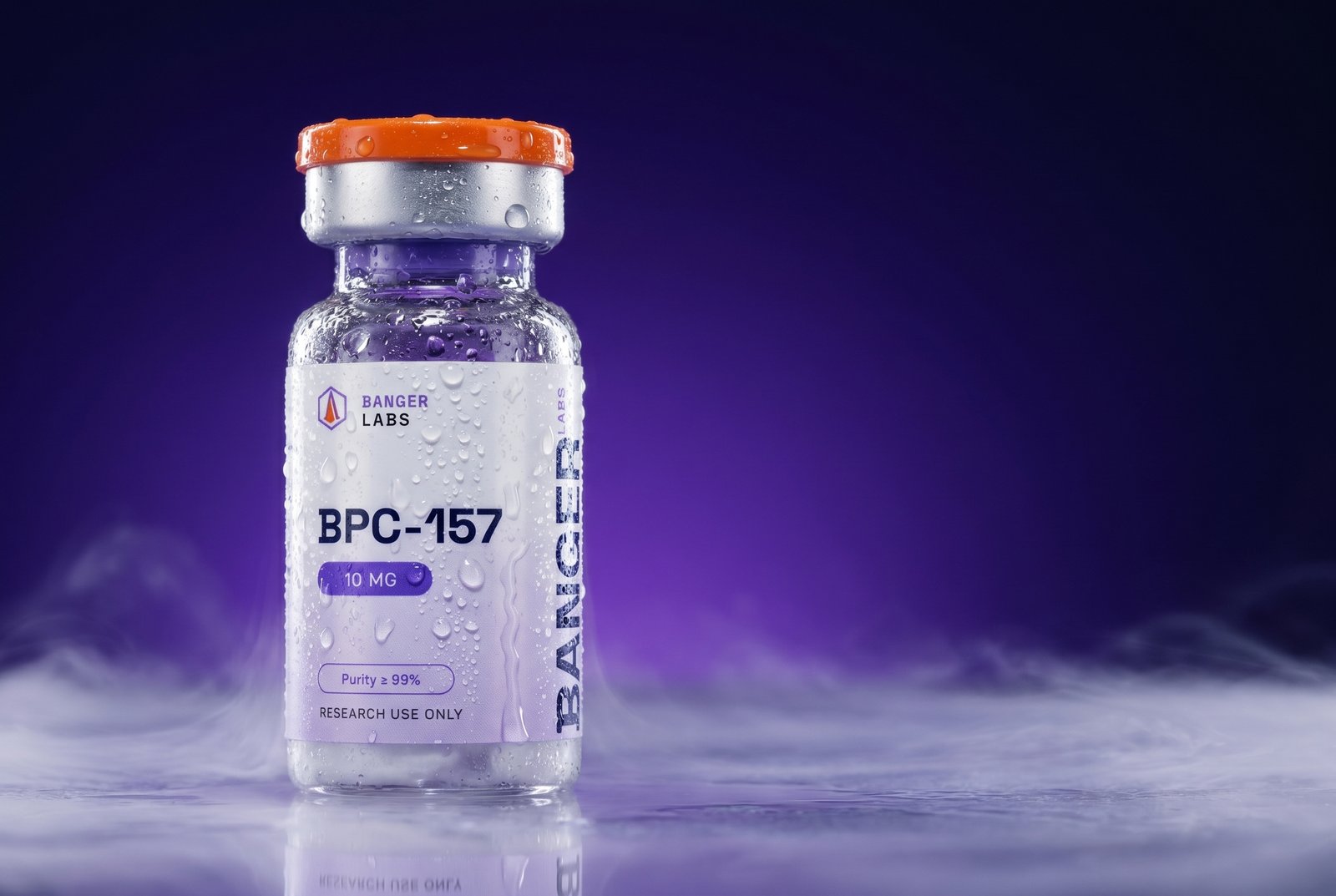
When a vial label reads “≥99%,” that single number is doing a lot of quiet work — and it is not the only number that matters. Purity (the proportion of the lyophilized solid that is the intended peptide) and net peptide content (how much of the powder is actually peptide rather than counter-ions and bound water) are distinct measurements that answer different questions. For research where reproducibility depends on knowing exactly what is in the vial, both belong on the Certificate of Analysis. This guide explains how each value is generated, what an HPLC chromatogram is really telling you, and how to read a CoA critically when comparing suppliers. Everything here is presented for research use only — not for human consumption.
Two Numbers, Two Questions: Purity vs. Net Peptide Content
The most common point of confusion in peptide quality is treating “purity” and “how much peptide is in the vial” as the same measurement. They are not. A vial can be 99% pure and still contain meaningfully less than its labeled mass in actual peptide, because lyophilized peptides are almost never delivered as the free base.
Purity (HPLC area %)
Purity describes the *fraction of the peptide-related material* that is your target sequence, expressed relative to all the other peptide-related species detected by HPLC. It answers: “Of the stuff that absorbs UV like a peptide, how much is the right one?” It says nothing about non-peptide mass such as trifluoroacetate (TFA) salt or residual water.
Net peptide content
Net peptide content (sometimes “peptide content” or “assay”) answers a different question: “Of the total dry mass in this vial, what percentage is actually peptide?” The remainder is typically counter-ions from synthesis and purification plus bound/residual water. Net content is determined by orthogonal methods — commonly amino acid analysis (AAA), nitrogen determination, or UV spectrophotometry — not by HPLC area %.
In short: purity is a quality measure (how clean), net peptide content is a quantity measure (how much). A complete CoA reports both. Our How to Read a Peptide CoA walks through where each appears on the document.
Where the Mass Goes: Salt, Water, and the Counter-Ion
Solid-phase peptide synthesis and the reversed-phase HPLC purification that follows leave the peptide as a salt. Many basic residues (lysine, arginine, histidine, and the free N-terminus) carry positive charge, and these are balanced by counter-ions — most often trifluoroacetate when TFA is the mobile-phase modifier, or acetate or hydrochloride after a salt exchange.
- Counter-ion salt — TFA, acetate, or HCl associated with basic sites. The more basic residues a sequence contains, the more counter-ion mass it carries.
- Residual/bound water — lyophilized peptides are hygroscopic and retain water; this contributes mass that is not peptide.
- The peptide itself — the free-base sequence, which is what net peptide content quantifies.
This is why two vials of the same labeled mass and the same HPLC purity can still differ in actual peptide delivered: a sequence rich in basic residues, or one supplied as a TFA salt rather than acetate, simply carries more non-peptide mass. None of this is an impurity in the contamination sense — it is an expected, documentable part of the material.
Reading the HPLC Chromatogram
Reversed-phase high-performance liquid chromatography (RP-HPLC) is the workhorse for peptide purity. A small amount of sample is injected onto a column, separated by hydrophobicity, and detected by UV absorbance — typically at 214 nm (the peptide bond absorbs strongly there) and/or 220 nm. The result is a chromatogram: peaks plotted against retention time.
What “area %” means
Each peak’s area is proportional to the amount of UV-absorbing material eluting at that time. Purity is reported as the area of the main peak divided by the total area of all peaks, expressed as a percentage. A clean, single, symmetric main peak with negligible neighbors is what ≥99% should look like.
What the chromatogram cannot tell you
- It does not, by itself, confirm *identity* — that the main peak is your sequence and not a different peptide. Identity comes from mass spectrometry (ESI-MS or MALDI-TOF), which should accompany the purity data on a complete CoA.
- It does not report non-UV-absorbing species (e.g., counter-ion salt, water), so HPLC area % is blind to net peptide content.
- Area % is detection-wavelength dependent. Co-eluting impurities or wavelength choice can flatter a result; a well-developed method and a stated wavelength are signs of rigor.
A trustworthy CoA pairs HPLC purity with an MS spectrum confirming the expected molecular weight. Purity without identity is an incomplete picture.
The Impurity Profile: What’s in the Other Fraction
When a CoA reports ≥99% purity, the remaining ≤1% of peptide-related material is the impurity profile. In synthetic peptides these impurities are predictable and sequence-related rather than random contamination:
- Deletion/truncation sequences — chains missing one or more residues from incomplete coupling during synthesis.
- Incomplete deprotection — residual side-chain protecting groups not fully cleaved.
- Oxidation products — especially at methionine, cysteine, or tryptophan.
- Deamidation / isomerization — at asparagine and glutamine, often time- and pH-dependent.
- Aggregation or adducts — minor higher-mass species.
These related substances tend to be structurally and chromatographically close to the target, which is exactly why they are hard to remove and why the last fraction of a percent of purity is the most expensive to achieve. The shape of the impurity profile — many tiny peaks vs. one significant shoulder — is itself informative about how cleanly the material was made and handled.
Why ≥99% Matters for Reproducible Research
For a research material, purity is not about chasing a marketing number — it is about controlling experimental variables. Impurities and unquantified non-peptide mass introduce noise that undermines reproducibility in several concrete ways.
- Concentration accuracy. If net peptide content is unknown, prepared concentrations are uncertain by the salt-plus-water fraction — which can be tens of percent. That uncertainty propagates into every downstream measurement.
- Confounding signals. A deletion sequence or oxidized variant may behave differently in an in-vitro assay than the target, adding a confound that is invisible unless purity is high and characterized.
- Lot-to-lot consistency. Reproducing a result across lots requires that each lot be comparably pure and comparably quantified; a tight impurity profile and a stated net content make lots comparable.
- Stability baselines. You cannot interpret degradation over time without a clean, well-characterized starting point.
≥99% HPLC purity *combined with* a reported net peptide content and MS identity gives a defined, documentable starting material. That documentation is the foundation of reproducible work — and it is why a careful lab treats the CoA, not the label, as the source of truth.
How to Compare Vendors Without Being Misled
Because “purity” and “content” can be presented selectively, comparing suppliers requires reading past the headline number. Use a consistent checklist rather than the largest font on the page.
| What to check | Strong signal | Weak / incomplete signal |
|---|---|---|
| HPLC purity | Stated method and detection wavelength; lot-specific chromatogram provided | A bare “99%” with no chromatogram or method |
| Net peptide content | Reported via AAA/nitrogen/UV, lot-specific | Omitted entirely (purity quoted as if it were content) |
| Identity (MS) | ESI-MS or MALDI confirming expected mass | No mass spec; purity only |
| Lot specificity | CoA tied to the lot number you receive | Generic CoA reused for all lots |
| Counter-ion / salt form | Disclosed (e.g., TFA vs. acetate) | Unspecified |
- Match the lot. A CoA is only meaningful if its lot number matches the vial you receive. A generic, undated certificate is a document, not evidence.
- Don’t equate purity with content. A vendor quoting only ≥99% purity has told you nothing about how much peptide is in the vial.
- Look for the full data package. HPLC + MS + net content together is the standard; one number alone is not.
If you want to see how a complete certificate is structured, our CoA library and the How to Read a Peptide CoA guide show the layout in detail. For the broader question of how to evaluate a supplier’s transparency, see Is Banger Labs Legit?. Reference materials such as BPC-157 and TB-500 within the Fragments & Copper Peptides category each carry their own lot-specific analytics.
Common questions
Is ≥99% purity the same as 99% peptide content?
No. ≥99% purity is an HPLC area-% measure describing how much of the peptide-related material is your target sequence. Net peptide content is a separate measurement of how much of the total dry powder is actually peptide versus counter-ion salt and bound water. A vial can be ≥99% pure while its net peptide content is lower, because salt and water make up part of the mass. Both numbers are correct and measure different things.
Why does my vial weigh more than the labeled peptide amount?
Lyophilized peptides are supplied as salts (often TFA, acetate, or HCl counter-ions) and retain residual water. That non-peptide mass is added to the peptide itself, so the total fill weight exceeds the net peptide it contains. This is expected, not contamination — it is exactly what net peptide content on the CoA quantifies.
Does HPLC purity confirm the peptide is the right sequence?
No. HPLC area % tells you how clean the main peak is relative to other peptide-related peaks, but it does not confirm identity. Identity is established by mass spectrometry (ESI-MS or MALDI-TOF) confirming the expected molecular weight. A complete CoA pairs HPLC purity with an MS spectrum; purity alone is an incomplete characterization.
What kinds of impurities make up the remaining ≤1%?
In synthetic peptides the impurity profile is typically sequence-related: deletion or truncation sequences from incomplete coupling, residual protecting groups, oxidation products (often at methionine, cysteine, or tryptophan), deamidation at asparagine or glutamine, and minor adducts or aggregates. These are predictable, chromatographically close to the target, and the reason the final fraction of purity is the hardest to achieve.
How should I compare purity claims between two suppliers?
Compare the full data package, not the headline number. Confirm a lot-specific HPLC chromatogram with a stated method and detection wavelength, a reported net peptide content from an orthogonal method (AAA, nitrogen, or UV), and MS identity. Verify the CoA’s lot number matches the vial you receive. A bare “99%” with no chromatogram, no net content, and no mass spec is a weaker signal than a complete, lot-matched certificate — regardless of the printed percentage.
Related research reading
References
- U.S. Pharmacopeia (USP) General Chapter <1503> Quality Attributes of Synthetic Peptide Drug Substances — overview of purity, related substances, and net peptide content concepts. https://www.usp.org/
- National Center for Biotechnology Information (NCBI), PubChem — peptide compound records including molecular weight and structure data used for identity confirmation. https://pubchem.ncbi.nlm.nih.gov/
- Snyder, L.R., Kirkland, J.J., Dolan, J.W. — Introduction to Modern Liquid Chromatography (reversed-phase HPLC principles and area-% quantitation), Wiley.
- Mant, C.T., Hodges, R.S. (eds.) — High-Performance Liquid Chromatography of Peptides and Proteins: Separation, Analysis, and Conformation, CRC Press.
Banger Labs supplies materials for laboratory and research use only. Not for human consumption. Not intended to diagnose, treat, cure, or prevent any disease. Statements have not been evaluated by the FDA.
Shop research peptides
Research-grade, ≥ 99% HPLC standard, COA per batch:
- How to Read a Peptide COA →
- Peptide Reconstitution & Storage Guide →
- Lyophilized vs Reconstituted Peptides: Stability, Shelf Life & Handling →
Browse the full Research Library →
For research use only. Not for human or veterinary use. Not a drug, food, or cosmetic.