Sermorelin, CJC-1295, and tesamorelin all belong to the same structural family: synthetic analogs of growth hormone–releasing hormone (GHRH), the hypothalamic peptide that signals the anterior pituitary to secrete growth hormone. Yet within that single family they sit at very different points along a spectrum of half-life, structural modification, and stability. Mapping where each compound falls — and why those differences exist at the molecular level — is the most useful way to understand the GHRH analog landscape. This guide treats the three side by side, for research use only and not for human consumption, and attributes every mechanistic statement to the preclinical, in-vitro, and clinical literature in which it was established.
The GHRH Analog Family: A Shared Starting Point
Native human GHRH is a 44–amino-acid peptide, but its full biological activity resides in the first 29 residues — the fragment known as GHRH(1-29), or sermorelin. Every compound in this comparison is built on that same N-terminal active core. They differ in what has been added to, or substituted within, that scaffold to alter how long the molecule survives in circulation and how strongly it resists enzymatic breakdown.
This shared lineage matters for interpretation. Because all three engage the same GHRH receptor on pituitary somatotrophs, the published preclinical and clinical literature describes a broadly similar *type* of pituitary signaling. What separates them is pharmacokinetics — the duration and shape of that signal — rather than a fundamentally different mechanism of action. As researchers in this space have noted, GHRH analogs are best understood as a continuum of stability rather than as wholly distinct tools.
Why GHRH analogs differ from GHRP/ghrelin-class peptides
It is worth situating this family against a neighboring one. GHRH analogs act at the GHRH receptor. By contrast, the growth hormone secretagogues — such as ipamorelin, GHRP-2, and GHRP-6 — act at the ghrelin/GHS receptor, a separate target. The two classes are frequently studied together in the literature because they engage distinct, complementary pituitary pathways. This article stays within the GHRH branch; the secretagogue branch is a separate comparison entirely.
Sermorelin: The Unmodified Active Fragment
Sermorelin is GHRH(1-29) with no further stabilizing modifications — essentially the minimal active sequence of native GHRH. Of the three compounds, it is the most structurally faithful to the endogenous hormone, and correspondingly the shortest-lived in circulation. The published pharmacokinetic literature describes a circulating half-life on the order of minutes, reflecting rapid cleavage by dipeptidyl peptidase-4 (DPP-4) and other plasma peptidases that act on the exposed N-terminus.
In the preclinical and clinical record, sermorelin has been studied primarily as a tool for probing pituitary GH-releasing capacity — historically including its use as a diagnostic agent to assess somatotroph responsiveness. Because its signal is brief and pulsatile, researchers have characterized it as producing a release profile closer in shape to physiological GHRH pulses than the longer-acting analogs do.
- Structure: GHRH(1-29), unmodified
- Half-life: short (minutes range) per published PK literature
- Studied for (preclinical/clinical): probing somatotroph responsiveness; reference GHRH-analog activity
- Signal shape: brief, pulsatile, closest to native GHRH
For sourcing and certificate-of-analysis details on this compound, see the sermorelin acetate product page.
CJC-1295: One Name, Two Very Different Molecules
CJC-1295 is the single most important source of confusion in this family, because the name is used for two distinct constructs with dramatically different half-lives. Both begin from the same modified GHRH(1-29) backbone — bearing several amino-acid substitutions (commonly described in the literature as including a D-Ala substitution at position 2, among others) that confer resistance to DPP-4 cleavage. The divergence is whether the molecule also carries a Drug Affinity Complex (DAC).
CJC-1295 without DAC (often called Mod GRF 1-29)
Without the DAC moiety, this construct relies only on its enzymatic-resistance substitutions. That makes it considerably more stable than unmodified sermorelin, but it remains relatively short-acting — its half-life is measured in the range of roughly half an hour to a couple of hours in the published characterizations, far short of the DAC version. In the literature it is frequently studied as a shorter-pulse GHRH analog.
CJC-1295 with DAC
The DAC is a maleimido-propionyl group that allows the peptide to bind covalently to circulating serum albumin shortly after entering the bloodstream. Because albumin is a long-lived plasma protein, this tethering shields the peptide from clearance and extends its circulating half-life to roughly a week — orders of magnitude longer than any other compound in this comparison. The published research describes this as producing a sustained elevation of GH-releasing signal rather than a discrete pulse.
Our CJC-1295 DAC listing is the DAC-bearing, long-acting form; check the certificate of analysis to confirm identity and purity.
Tesamorelin: A Stabilized Full-Length Analog
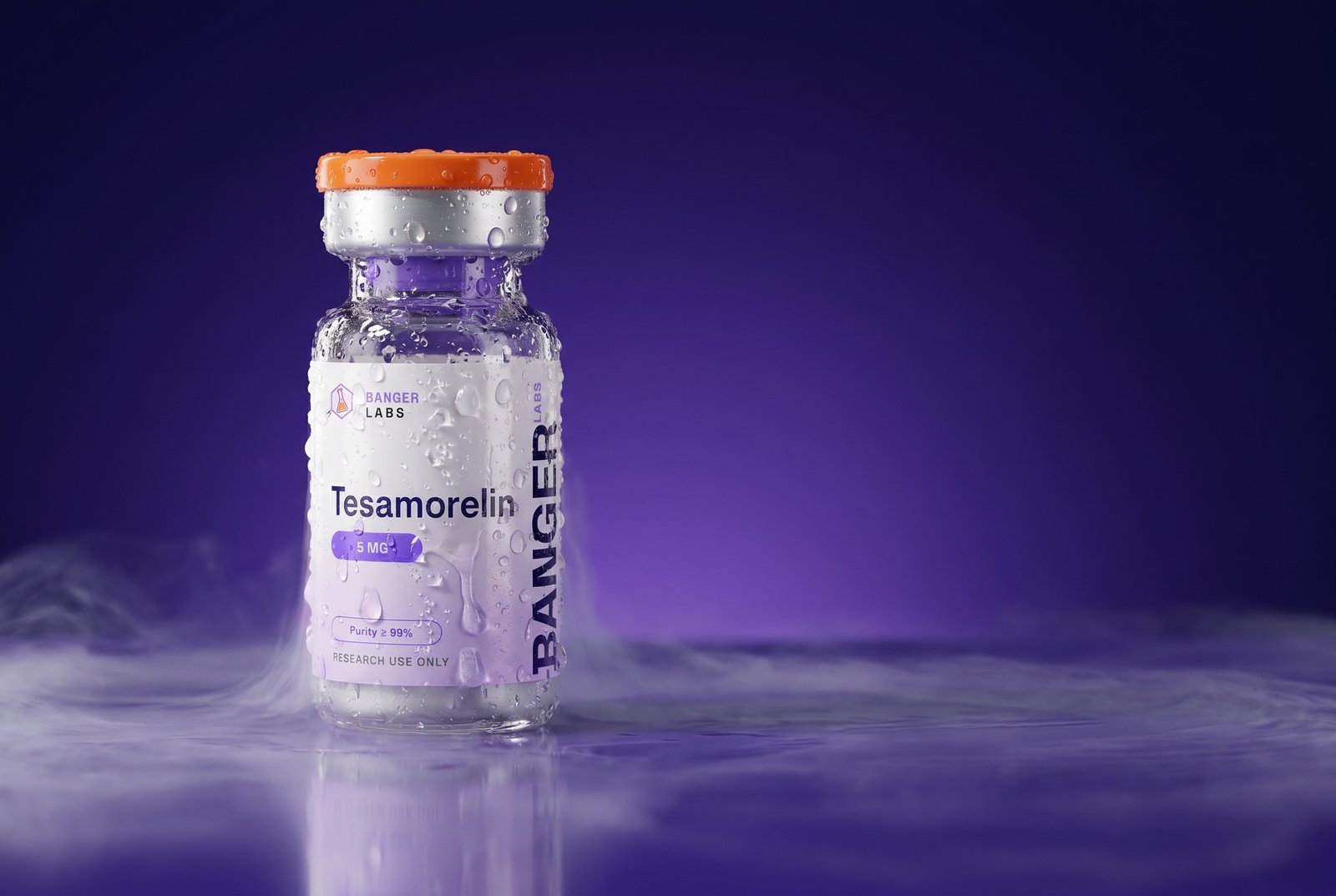
Tesamorelin takes a different engineering approach from CJC-1295. Rather than truncating to GHRH(1-29) and substituting residues, tesamorelin is a stabilized analog of the full-length GHRH(1-44) sequence, modified at the N-terminus with a trans-3-hexenoyl group. This acylation protects the molecule from rapid degradation while preserving GHRH-receptor activity.
Among the three, tesamorelin has the most substantial body of formal clinical investigation, and it is the only one in this group to have reached regulatory approval for a specific clinical indication (the reduction of excess visceral adipose tissue in a defined patient population). That clinical record makes it a well-characterized reference point in the GHRH-analog literature. None of this constitutes a usage recommendation — these compounds are offered here strictly for research, and the clinical history is cited only to characterize how well-studied the molecule is.
Its half-life sits in an intermediate position: longer than unmodified sermorelin, but far shorter than the albumin-tethered CJC-1295 with DAC. Published characterizations place tesamorelin’s circulating half-life in the range of tens of minutes.
See the tesamorelin product page for CoA and form details, and browse related compounds in the secretagogues research category.
Side-by-Side Comparison
The table below summarizes the structural and pharmacokinetic differences. Half-life figures are approximate ranges drawn from the published literature and are presented to illustrate relative scale, not as precise constants — actual values vary with assay, species, and formulation.
| Compound | Backbone | Key modification | Approx. half-life (literature) | Signal profile |
|---|---|---|---|---|
| Sermorelin | GHRH(1-29) | None (active fragment only) | Minutes (shortest) | Brief, pulsatile — closest to native GHRH |
| CJC-1295 without DAC (Mod GRF 1-29) | GHRH(1-29) | DPP-4-resistant substitutions (e.g., D-Ala²) | ~30 min to ~2 hours | Short pulse, stabilized |
| CJC-1295 with DAC | GHRH(1-29) | Same substitutions + DAC (albumin-binding) | ~Days (about a week) | Sustained, prolonged elevation |
| Tesamorelin | GHRH(1-44) full-length | N-terminal trans-3-hexenoyl group | Tens of minutes | Intermediate; most clinically characterized |
Read top to bottom, the table is essentially a stability ladder: from the unmodified, minute-scale sermorelin, through the substitution-stabilized and intermediate-duration forms, to the week-long albumin-tethered CJC-1295 with DAC at the far end.
Stability, Forms, and Handling for Research
All of these constructs are supplied as lyophilized (freeze-dried) powders, which is the standard stable form for peptides of this class. In the dry, lyophilized state and kept cold, these peptides are comparatively stable for extended periods. Stability becomes the limiting concern after reconstitution, when the peptide is in aqueous solution and again exposed to hydrolysis and, in some cases, oxidation.
- Store lyophilized powder cold and protected from light and moisture per the certificate of analysis
- Reconstitute with an appropriate diluent only when needed for an experiment
- Keep reconstituted solution refrigerated and use within the window indicated by stability data
- Avoid repeated freeze-thaw cycles, which can degrade peptide integrity
The general principles are the same across the family, but the more heavily modified molecules (the DAC-bearing and acylated forms) are engineered specifically for circulating stability in vivo and should not be assumed to be more stable on the bench than a simpler fragment — handling still follows the CoA. For a full walkthrough, see our guides on peptide reconstitution and storage and how to read a peptide CoA.
Within the GHRH family, structure dictates stability and stability dictates the signal profile — which is why half-life, not mechanism, is the axis that actually separates these three compounds.
Choosing a Reference Point in the Family
For a researcher mapping this family, the practical takeaway is that the three compounds occupy complementary positions rather than competing for a single role. Sermorelin is the closest analog to native GHRH and the natural reference for short, pulsatile signaling. CJC-1295 — once the DAC question is resolved — offers either a stabilized short pulse (no DAC) or a sustained week-long elevation (with DAC). Tesamorelin is the most extensively clinically characterized of the group and serves as a well-documented full-length reference.
Because they share a receptor and a lineage, the literature on one frequently informs interpretation of the others. The differences that matter are the ones catalogued above: backbone length, the specific stabilizing modification, and the resulting half-life. Selecting among them for a given research model is fundamentally a question of what signal duration the experiment requires.
To confirm any supplier’s identity and purity claims before relying on a compound, review the certificate of analysis and our overview of why Banger Labs is independently verifiable.
Common questions
What is the single biggest difference between sermorelin, CJC-1295, and tesamorelin?
Half-life. All three engage the same GHRH receptor, so the practical distinction is how long they circulate: sermorelin is minute-scale, tesamorelin is tens of minutes, CJC-1295 without DAC is roughly 30 minutes to a couple of hours, and CJC-1295 with DAC extends to roughly a week because it binds covalently to serum albumin.
Why is ‘CJC-1295’ so often confused?
Because the name covers two different molecules. CJC-1295 without DAC (also called Mod GRF 1-29) is short-acting, while CJC-1295 with DAC carries an albumin-binding moiety that extends its half-life to about a week. Always confirm which form a source is describing — they are not interchangeable.
Is tesamorelin a GHRH(1-29) fragment like the others?
No. Sermorelin and both CJC-1295 forms are built on the GHRH(1-29) active fragment, whereas tesamorelin is a stabilized analog of the full-length GHRH(1-44) sequence with an N-terminal trans-3-hexenoyl modification. It is the only one in this group with a formal regulatory approval for a defined clinical indication, which is noted here only to characterize how well-studied it is — not as a usage recommendation.
How should these peptides be stored for research?
All are supplied lyophilized. Keep the dry powder cold, dark, and dry per the certificate of analysis; reconstitute only when needed; refrigerate the solution and use it within its stability window; and avoid repeated freeze-thaw cycles. See our reconstitution and storage guide for specifics.
Are these compounds intended for human use?
No. Every compound discussed here is offered strictly for in-vitro and laboratory research use only and not for human consumption. All mechanistic and clinical statements in this article are attributed to the published preclinical and clinical literature for characterization purposes, not as protocols or recommendations.
Related research reading
References
- Teichman SL, et al. Prolonged stimulation of growth hormone and IGF-1 secretion by CJC-1295, a long-acting analog of GHRH, in healthy adults. Journal of Clinical Endocrinology & Metabolism. (Primary clinical characterization of CJC-1295 with DAC and albumin binding.)
- Falutz J, et al. Tesamorelin (a GHRH analog) clinical trials on visceral adipose tissue. New England Journal of Medicine / Journal of Clinical Endocrinology & Metabolism. (Primary clinical literature characterizing tesamorelin.)
- U.S. National Library of Medicine, PubChem — Sermorelin, Tesamorelin compound records. https://pubchem.ncbi.nlm.nih.gov/
- U.S. National Center for Biotechnology Information (NCBI/PubMed), growth hormone–releasing hormone analog literature. https://pubmed.ncbi.nlm.nih.gov/
Banger Labs supplies materials for laboratory and research use only. Not for human consumption. Not intended to diagnose, treat, cure, or prevent any disease. Statements have not been evaluated by the FDA.
Shop research peptides
Research-grade, ≥ 99% HPLC standard, COA per batch:
- BPC-157 vs TB-500: Research Comparison →
- CJC-1295 vs Ipamorelin: Research Comparison →
- GHRP-2 vs GHRP-6 vs Ipamorelin vs Hexarelin: Growth-Hormone Secretagogue Comparison →
Browse the full Research Library →
For research use only. Not for human or veterinary use. Not a drug, food, or cosmetic.