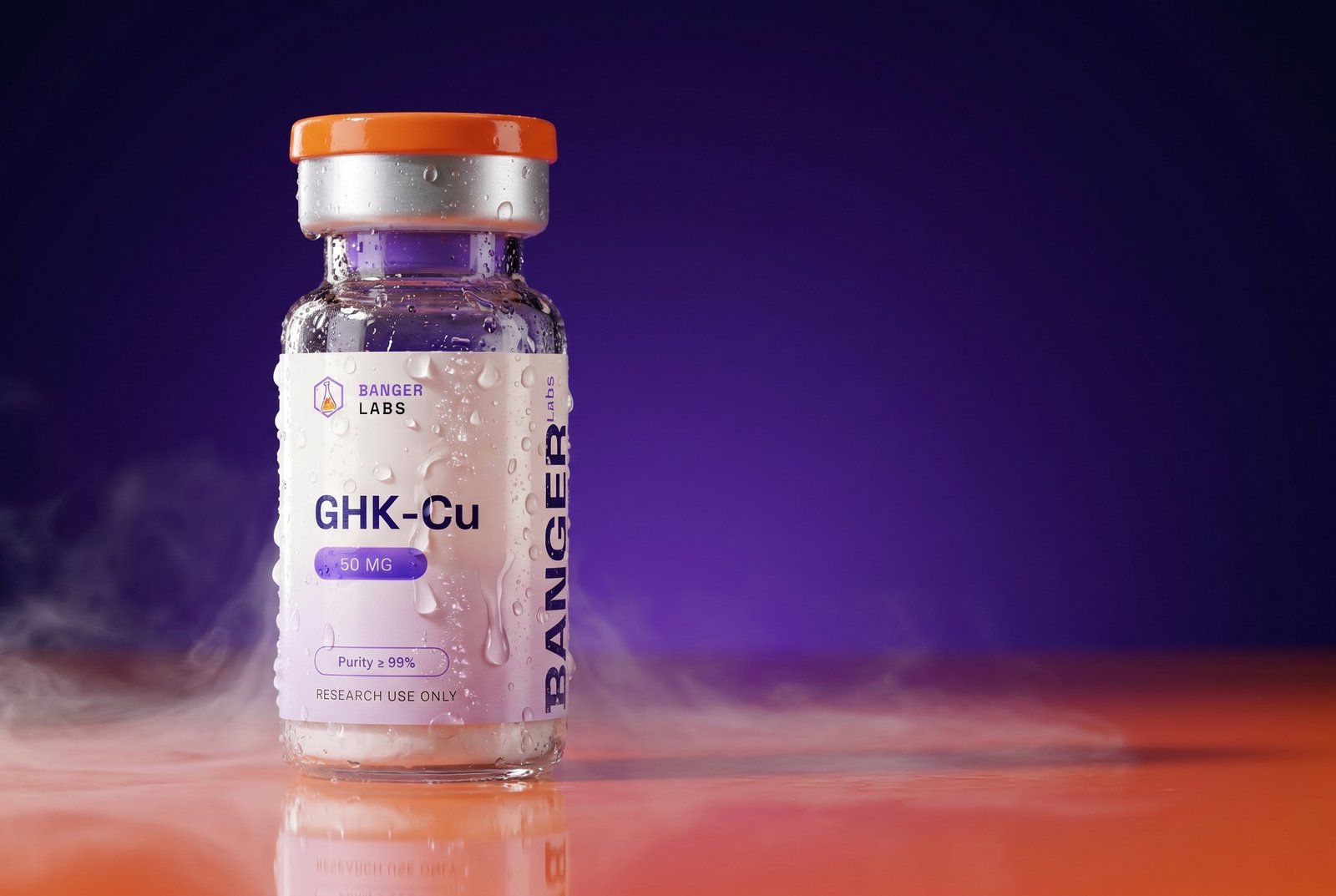
GHK-Cu — the copper-bound form of the tripeptide glycyl-L-histidyl-L-lysine — occupies an unusual place in the peptide literature: it is at once one of the oldest molecules studied (first isolated from human plasma in the 1970s) and one of the most chemically distinctive, because its biology is inseparable from the copper(II) ion it carries. This overview is written for laboratory and research audiences and is presented strictly for research use only — not for human consumption. Below we cover what GHK-Cu actually is, the coordination chemistry behind its copper binding, the preclinical and in-vitro literature on extracellular-matrix and tissue remodeling, the practical differences between lyophilized and topical research forms, and how the compound is handled in a research setting.
What GHK-Cu Is
GHK is a naturally occurring tripeptide with the sequence glycine-histidine-lysine (Gly-His-Lys). It was originally identified by Loren Pickart in human plasma, where its concentration is reported to decline with age in the literature. On its own GHK is a small, water-soluble peptide; its defining research property is a very high affinity for copper(II) ions. When GHK chelates a single Cu²⁺ ion, the resulting complex is designated GHK-Cu (copper tripeptide-1, or copper peptide).
It is the copper complex, not the bare peptide, that most preclinical studies treat as the active species. The histidine imidazole and the terminal amine groups create a coordination geometry well suited to copper, and much of the molecule’s reported in-vitro activity is attributed to its role as a copper carrier and exchanger rather than to the peptide backbone alone.
For a starting point on the specific material discussed here, see the GHK-Cu product page and the broader fragments & copper peptides research category, which groups peptides commonly studied in tissue-remodeling models.
The Copper-Binding Mechanism
The chemistry that makes GHK-Cu interesting is its copper coordination. The tripeptide binds Cu²⁺ with high affinity, and the literature describes the imidazole nitrogen of the histidine residue, together with backbone nitrogen atoms and the N-terminal amine, as the principal donor groups in the coordination sphere. This arrangement places GHK among the well-characterized small-molecule copper chelators in biochemistry.
Why copper matters here
Copper is a required cofactor for several enzymes involved in connective-tissue chemistry, including lysyl oxidase (collagen/elastin cross-linking) and superoxide dismutase (antioxidant defense). In the preclinical literature, GHK is frequently framed as a physiological copper-transport molecule — a species that can pick up, carry, and exchange copper with other ligands and cellular acceptors. Its proposed activities are therefore often discussed as copper-delivery effects rather than independent peptide signaling.
- High-affinity, selective binding of Cu²⁺ to form a 1:1 GHK-Cu complex
- Histidine imidazole as a key donor in the reported coordination geometry
- Function described in the literature as a copper carrier / exchanger
- Relevance to copper-dependent enzymes such as lysyl oxidase and SOD
In the biochemical literature GHK-Cu is best understood not as a peptide that happens to contain copper, but as a copper complex whose behavior is governed by the metal it carries.
Skin, Tissue & Remodeling Research
Most of the published GHK-Cu literature sits in dermatology and wound-healing research models — and it is almost entirely in-vitro and animal in nature. In cultured fibroblast and skin-equivalent systems, GHK-Cu has been studied for its reported influence on extracellular-matrix (ECM) genes, with investigators examining changes in the expression of collagens, glycosaminoglycans, and matrix-remodeling enzymes such as matrix metalloproteinases (MMPs) and their inhibitors (TIMPs).
Gene-expression profiling work (notably Pickart and colleagues) has described GHK as modulating a broad set of genes in cultured cells, which is why review articles often characterize it as influencing tissue “remodeling” rather than a single pathway. These remain laboratory observations: cell-culture and animal endpoints, not demonstrated clinical outcomes.
Research themes reported in the literature
- Modulation of ECM component synthesis (collagen, glycosaminoglycans) in cultured cells
- Effects on MMP/TIMP balance studied in fibroblast and skin models
- Antioxidant-associated endpoints linked to copper enzyme cofactor roles
- Angiogenesis and wound-bed observations in animal models
- Broad gene-expression modulation in transcriptomic profiling studies
Researchers studying tissue-remodeling endpoints often compare GHK-Cu alongside other compounds in the same category; the fragments & copper peptides category collects materials frequently referenced in that literature, and our research disclaimer details the terms under which they are supplied.
Forms: Lyophilized vs Topical
GHK-Cu is encountered in research settings in two principal physical forms, and they are not interchangeable for handling purposes. Understanding the distinction matters for storage, stability, and the kind of experiment a sample is suited to.
| Property | Lyophilized GHK-Cu | Pre-mixed / Topical GHK-Cu |
|---|---|---|
| Physical state | Dry, freeze-dried powder (often deep blue from the Cu²⁺ complex) | Solubilized in an aqueous or cosmetic-style vehicle |
| Stability | Most stable; long shelf life when sealed, cool, and dark | Shorter working stability once in solution |
| Reconstitution | Required before use; researcher controls concentration | Already in solution; concentration fixed by the preparation |
| Typical research context | Quantitative in-vitro / biochemical assays | Surface-application and formulation studies |
| Handling sensitivity | Hygroscopic; protect from moisture | Sensitive to light, oxidation, and contamination over time |
The characteristic deep-blue color of GHK-Cu is itself a visual cue: it reflects the copper(II) complex. The blue tint is normal and expected for the chelated form. Lyophilized material gives a researcher the most control, because the final concentration and buffer are determined at reconstitution rather than fixed by a vendor’s premix.
For step-by-step handling of dry peptide material, see the peptide reconstitution & storage guide.
Handling, Storage & Stability
Because GHK-Cu is a metal complex, its handling has a few considerations beyond a generic peptide. Copper coordination is sensitive to pH extremes and to competing ligands, so buffer choice and solvent quality affect the integrity of the complex. As with all research peptides, lyophilized powder is the most stable form and benefits from cold, dark, low-moisture storage.
- Store the sealed lyophilized vial cold and protected from light until use.
- Allow vials to reach room temperature before opening to limit condensation onto hygroscopic powder.
- Reconstitute with appropriate research-grade solvent; the deep-blue color confirms the intact copper complex.
- Once in solution, treat as less stable — keep cold, minimize freeze-thaw cycles, and use within a working window.
- Avoid strong acids/bases and chelator-rich buffers (e.g., high EDTA) that can strip or compete for the copper ion.
Documentation matters as much as handling: review a certificate of analysis and learn how to read a peptide COA so identity, purity, and copper-complex content are verified before any experiment begins.
Summary
GHK-Cu is best understood as a high-affinity copper complex of the GHK tripeptide whose research interest flows directly from its coordination chemistry. The preclinical literature — overwhelmingly in-vitro and animal — explores its role in copper transport and in modulating extracellular-matrix and tissue-remodeling pathways, while practical research use turns on choosing the right form (stable lyophilized powder vs pre-mixed solution) and handling the copper complex with appropriate care.
None of this constitutes evidence of human efficacy or safety, and GHK-Cu is offered strictly for research use only — not for human consumption. For sourcing, see the GHK-Cu page and the fragments & copper peptides category.
Common questions
Why is GHK-Cu blue?
The deep-blue color is the visual signature of the copper(II) ion coordinated by the tripeptide. An intact GHK-Cu complex is expected to show this blue tint; it is a normal property of the chelated form, not a sign of contamination. This is for research-use context only.
What is the difference between GHK and GHK-Cu?
GHK is the bare glycyl-histidyl-lysine tripeptide. GHK-Cu is that same peptide bound to a copper(II) ion in a 1:1 complex. In most preclinical studies the copper-bound form is treated as the active species, because much of the reported in-vitro activity is attributed to GHK’s role as a copper carrier.
Which form is more stable for research storage?
Lyophilized (freeze-dried) powder is the most stable form and, when kept sealed, cold, and protected from light, has a long shelf life. Once reconstituted or supplied pre-mixed in solution, the material is less stable and should be kept cold with minimal freeze-thaw cycles and used within a working window.
What does the preclinical literature actually show?
The literature is largely in-vitro (cultured fibroblasts, skin equivalents) and animal-model based. It explores GHK-Cu’s reported influence on extracellular-matrix gene expression, MMP/TIMP balance, and copper-dependent enzyme cofactor roles. These are laboratory observations, not demonstrated human outcomes.
Are there buffers to avoid when working with GHK-Cu?
Because the molecule is a copper complex, strongly chelating buffers (such as high-EDTA preparations) and pH extremes can compete for or destabilize the copper ion. Researchers typically use mild, research-grade solvents and verify the intact complex by its characteristic blue color and against the certificate of analysis.
Related research reading
References
- Pickart L, Margolina A. Regenerative and Protective Actions of the GHK-Cu Peptide in the Light of the New Gene Data. International Journal of Molecular Sciences. 2018;19(7):1987.
- Pickart L. The human tripeptide GHK and tissue remodeling. Journal of Biomaterials Science, Polymer Edition. 2008;19(8):969-988.
- Pickart L, Vasquez-Soltero JM, Margolina A. GHK Peptide as a Natural Modulator of Multiple Cellular Pathways in Skin Regeneration. BioMed Research International. 2015;2015:648108.
- PubChem Compound Summary: Copper peptide (GHK-Cu / Glycyl-L-histidyl-L-lysine copper). National Center for Biotechnology Information. https://pubchem.ncbi.nlm.nih.gov/
Banger Labs supplies materials for laboratory and research use only. Not for human consumption. Not intended to diagnose, treat, cure, or prevent any disease. Statements have not been evaluated by the FDA.
Shop research peptides
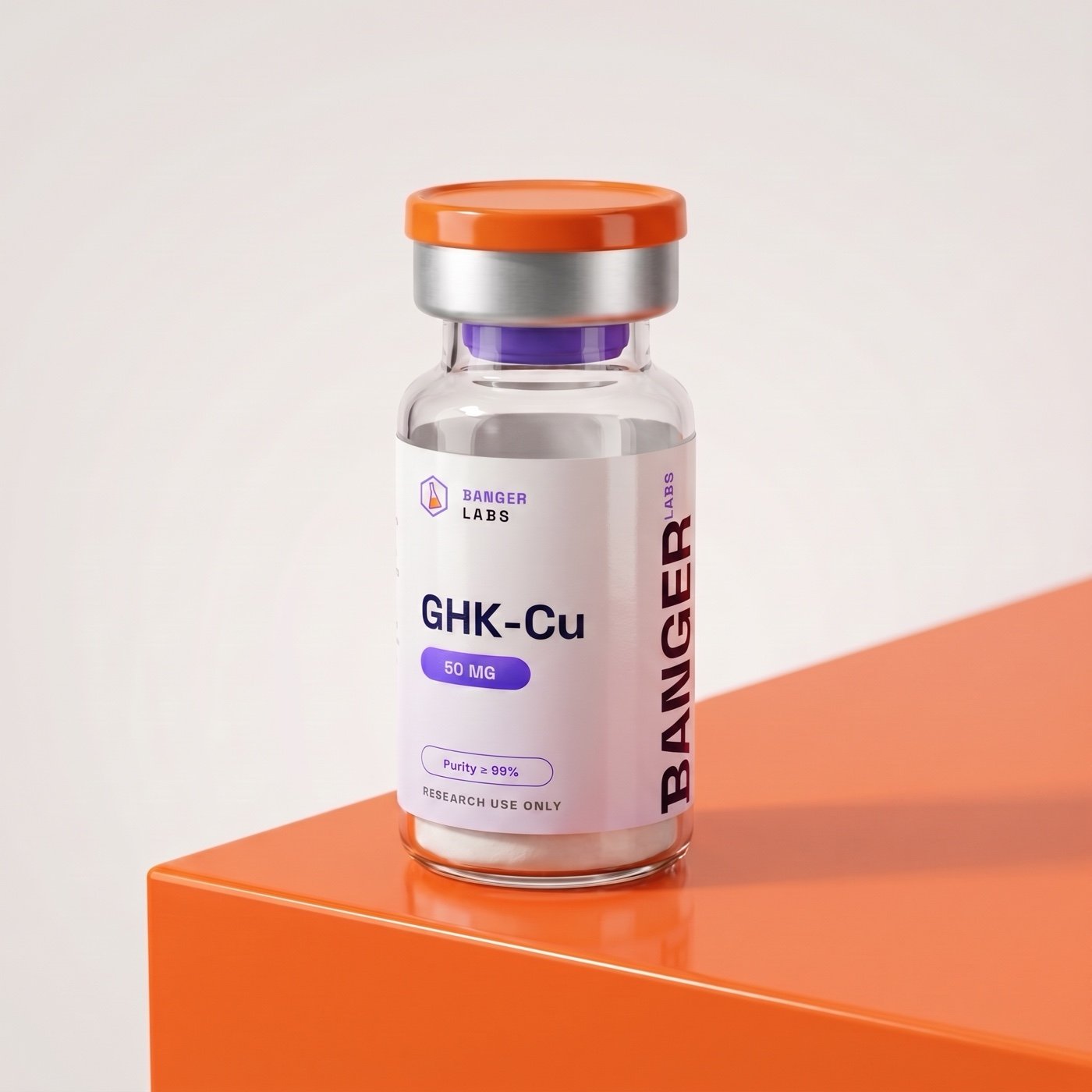
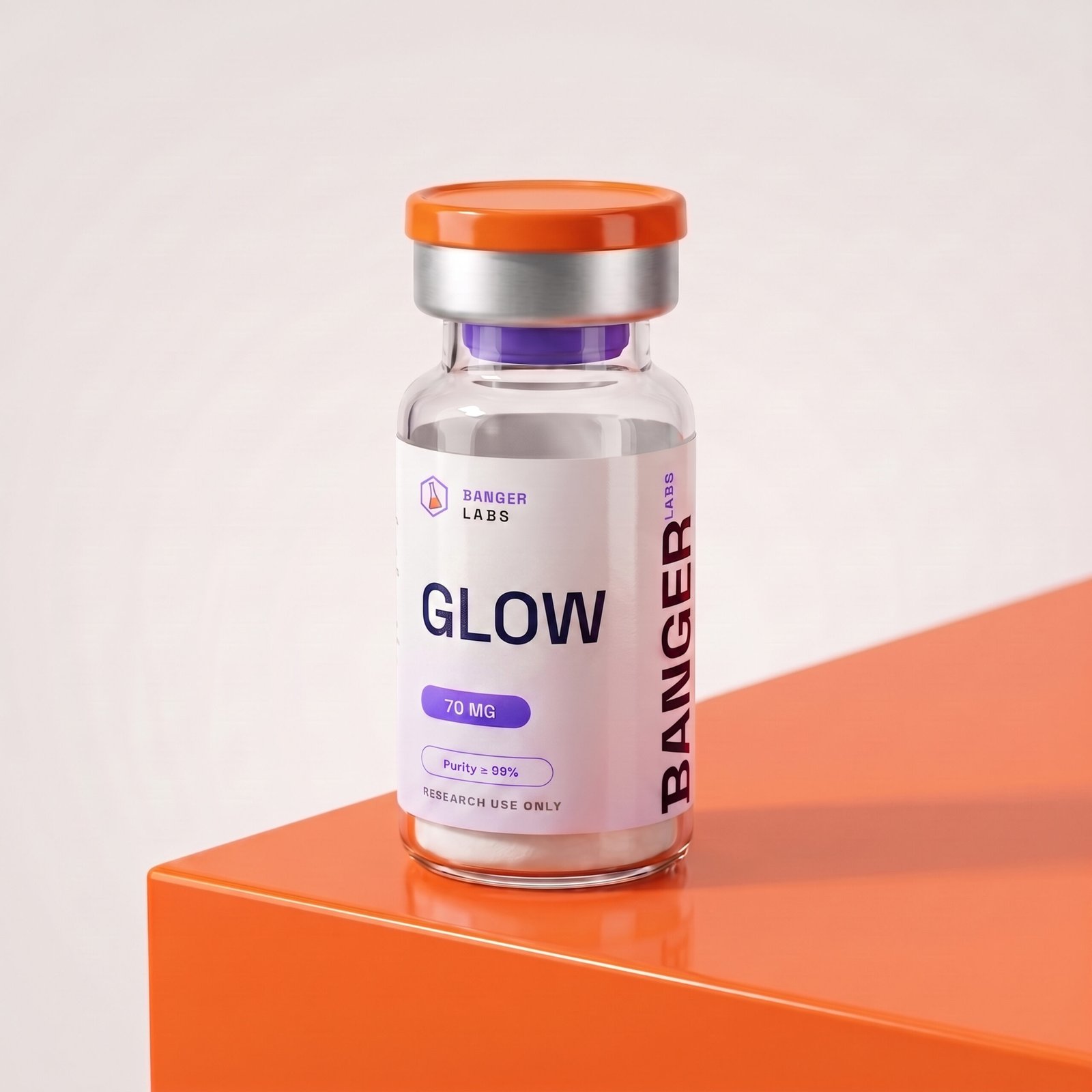
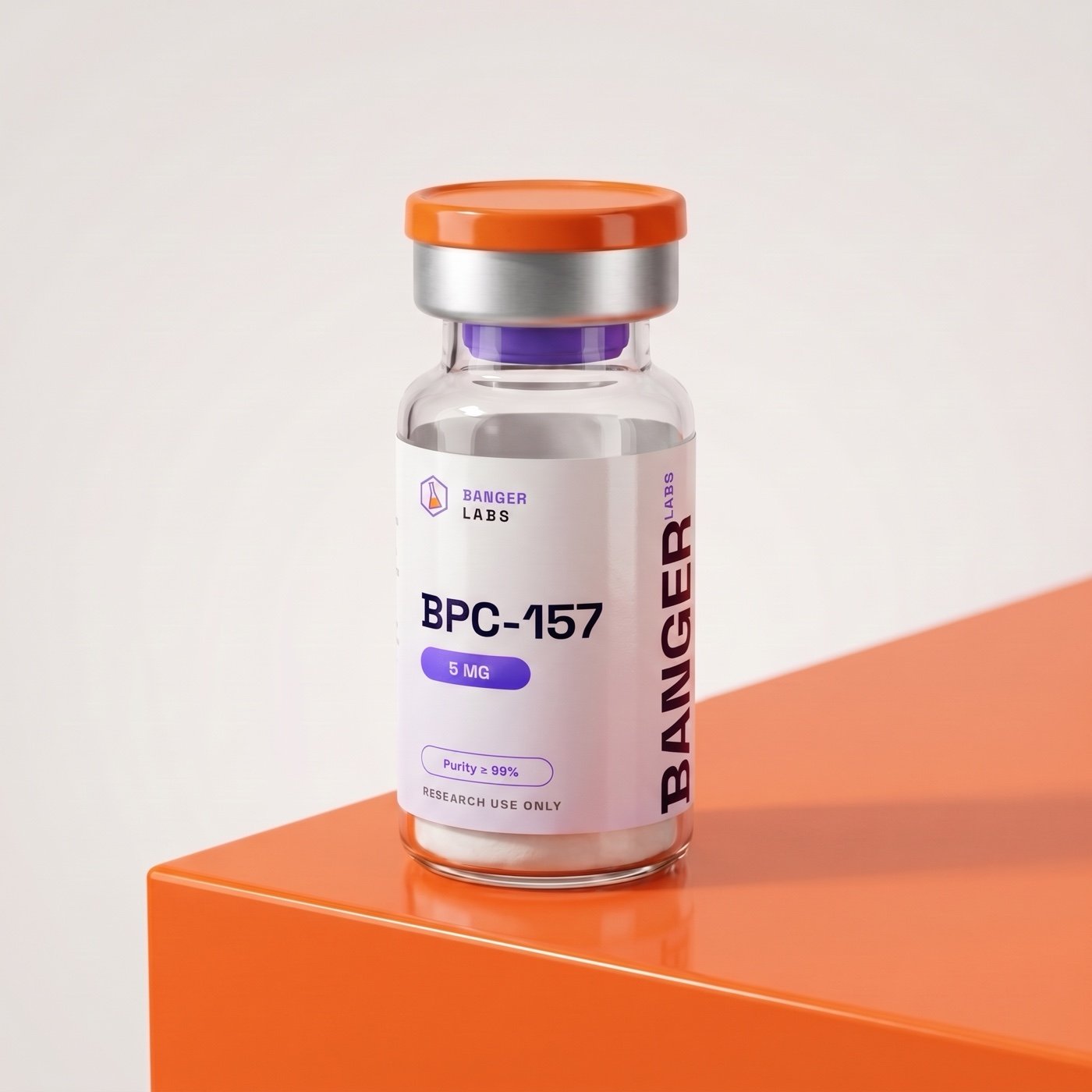
Research-grade, ≥ 99% HPLC standard, COA per batch:
- GLP-1 Class Research Peptides Explained: Incretin Biology, Single vs Dual vs Triple Agonists →
- Peptide Mechanisms of Action: How the Major Research Classes Work →
- Thymosin Alpha-1, Thymalin, LL-37 & TB-500: Immune & Repair Peptide Research →
Browse the full Research Library →
For research use only. Not for human or veterinary use. Not a drug, food, or cosmetic.