By the Banger Labs Research Team · Updated June 2026
PT-141 vs Kisspeptin-10 at a glance
What is PT-141?
PT-141 (bremelanotide) is a synthetic cyclic heptapeptide lactam derived from alpha-melanocyte-stimulating hormone (α-MSH), reported with the sequence Ac-Nle-cyclo[Asp-His-D-Phe-Arg-Trp-Lys]-OH. It was developed by Palatin Technologies and is structurally described as a deaminated derivative/metabolite of the earlier melanocortin analog melanotan II. It retains the His-Phe-Arg-Trp core pharmacophore characteristic of melanocortin ligands.
What is Kisspeptin-10?
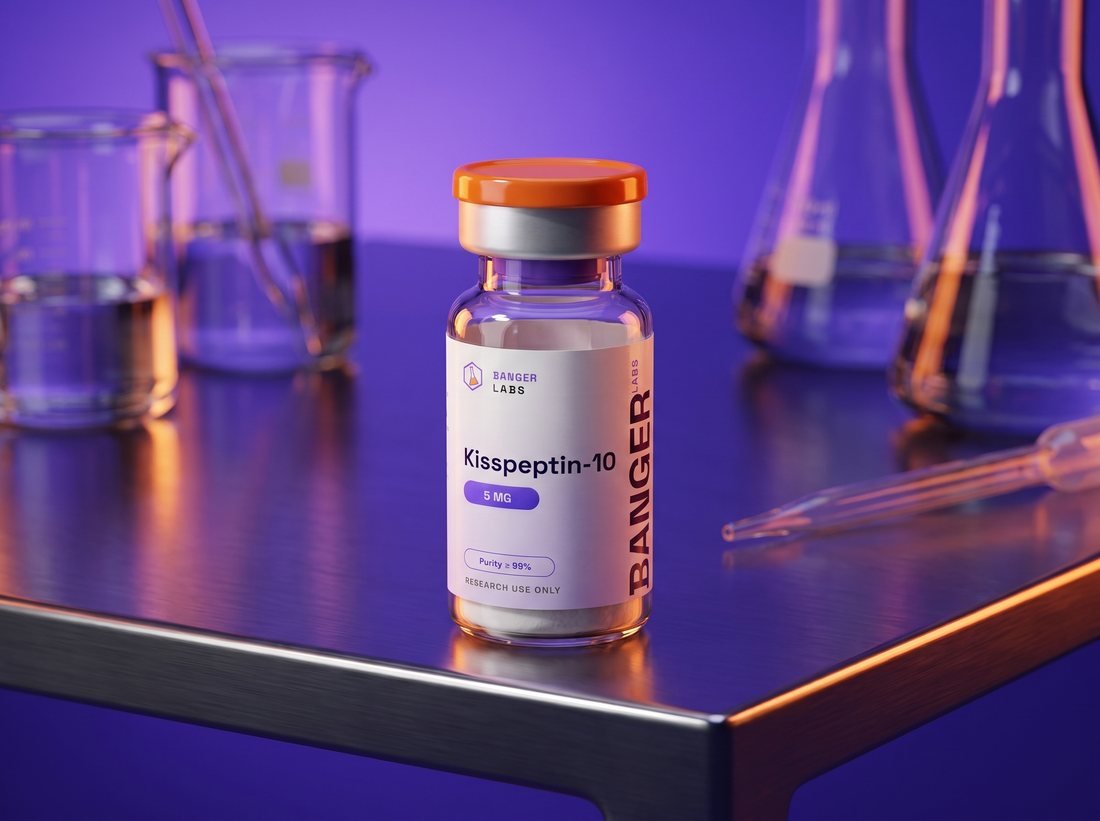
Kisspeptin-10 is the smallest fully active fragment of the kisspeptin family, derived from the C-terminal region of the 54-amino-acid kisspeptin (metastin) encoded by the KISS1 gene. Kisspeptins belong to the Arg-Phe-amide (RFamide) peptide family, and KP-10 shares the common C-terminal decapeptide sequence required for receptor binding. It is described in the literature as a research-grade peptide for in vitro and preclinical neuroendocrine studies.
How they differ
In published structural and pharmacology research, bremelanotide acts as an agonist at melanocortin receptors, with reported activity across the MC1R/MC3R/MC4R subtypes and highest reported affinity/potency at the melanocortin-4 receptor (MC4R). A cryo-EM structure (PDB 7F55) resolved bremelanotide bound to MC4R in complex with the heterotrimeric Gs protein, consistent with Gs-coupled receptor activation. These are receptor-level mechanistic observations from laboratory and structural studies only. By contrast, In reported research, kisspeptin-10 acts as an agonist at the kisspeptin receptor KISS1R (formerly GPR54), a G-protein-coupled receptor. Receptor activation has been characterized as coupling to Gq/11 and the phospholipase C / inositol-trisphosphate cascade, leading to intracellular calcium mobilization. In experimental models this signaling has been associated with depolarization and increased firing of GnRH-expressing neurons.
These describe laboratory/preclinical research only. No therapeutic, medical, or efficacy claims are made.
Frequently asked questions
Are PT-141 and Kisspeptin-10 the same?
No — see the comparison table above; they differ in class and the research contexts in which they are studied.
Are these research use only?
Yes. Both are supplied strictly for laboratory research — not for human or veterinary use.
References
- Structural insights into ligand recognition and activation of the melanocortin-4 receptor (Zhang et al., Cell Research 2021) — PubMed / Cell Research
- RCSB PDB 7F55: Cryo-EM structure of bremelanotide-MC4R-Gs_Nb35 complex — RCSB Protein Data Bank
- Usefulness of ambulatory blood pressure monitoring to assess the melanocortin receptor agonist bremelanotide (White et al.) — PubMed Central (PMC)
- International Union of Basic and Clinical Pharmacology. LXXVII. Kisspeptin receptor nomenclature, distribution, and function — Pharmacological Reviews (PubMed)
- Kisspeptins: a multifunctional peptide system with a role in reproduction, cancer and the cardiovascular system — British Journal of Pharmacology (PMC)
- KiSS-1 and GPR54 as new players in gonadotropin regulation and puberty — Endocrine (PubMed)
- Kisspeptin-10 (KP-10) stimulates osteoblast differentiation through GPR54-mediated regulation of BMP2 expression and activation — Scientific Reports (PMC)
Shop these research peptides
Shop PT-141 →Shop Kisspeptin-10 →
By the Banger Labs Research Team. For research use only. Not for human or veterinary use. Educational information, not medical advice.