By the Banger Labs Research Team · Updated June 2026
GHRP-2 vs GHRP-6 at a glance
What is GHRP-2?
GHRP-2, also known as pralmorelin (developmental codes KP-102, GPA-748, WAY-GPA-748), is a synthetic peptide of the growth hormone-releasing peptide (GHRP) family with the sequence H-D-Ala-D-2-Nal-Ala-Trp-D-Phe-Lys-NH2 (where D-2-Nal denotes D-2-naphthylalanine). It is classed as a hexapeptide (six amino-acid residues, molecular weight ~817.97) and was among the first synthetic growth hormone secretagogues described in the scientific literature. It is used in research settings as a tool compound for probing the growth hormone secretagogue / ghrelin-receptor system.
What is GHRP-6?
GHRP-6 is a synthetic hexapeptide with the amino acid sequence His-D-Trp-Ala-Trp-D-Phe-Lys-NH2, characterized in work by Bowers and colleagues (Endocrinology, 1984) describing a synthetic hexapeptide shown to release growth hormone from the pituitary in vitro and in vivo through a mechanism distinct from growth hormone-releasing hormone (GHRH). It belongs to the growth hormone secretagogue (GHS) class and is regarded as a prototype of the GHRP family. It is supplied and handled as a research chemical for in vitro and non-human laboratory investigation only.
How they differ
In published research, GHRP-2 acts as an agonist at the growth hormone secretagogue receptor type 1a (GHS-R1a), the same G-protein-coupled receptor bound by the endogenous peptide ghrelin, which is expressed in the anterior pituitary and hypothalamus. Receptor activation is associated in preclinical models with Gq/11–phospholipase C signaling and stimulation of growth hormone release from pituitary somatotrophs. Studies also report interactions with other signaling pathways, including opioid-receptor-linked effects observed in rodent models. By contrast, In research models GHRP-6 acts as an agonist at the growth hormone secretagogue receptor type 1a (GHS-R1a), later identified as the ghrelin receptor, making it a functional ghrelin mimetic. Receptor activation on pituitary somatotrophs is associated in the literature with intracellular signaling (including increased intracellular calcium) linked to pulsatile growth hormone release, and hypothalamic GHS-R1a activation is studied in food-intake/appetite signaling models. Some preclinical reports also describe interaction with the scavenger receptor CD36 and growth-hormone-independent signaling pathways.
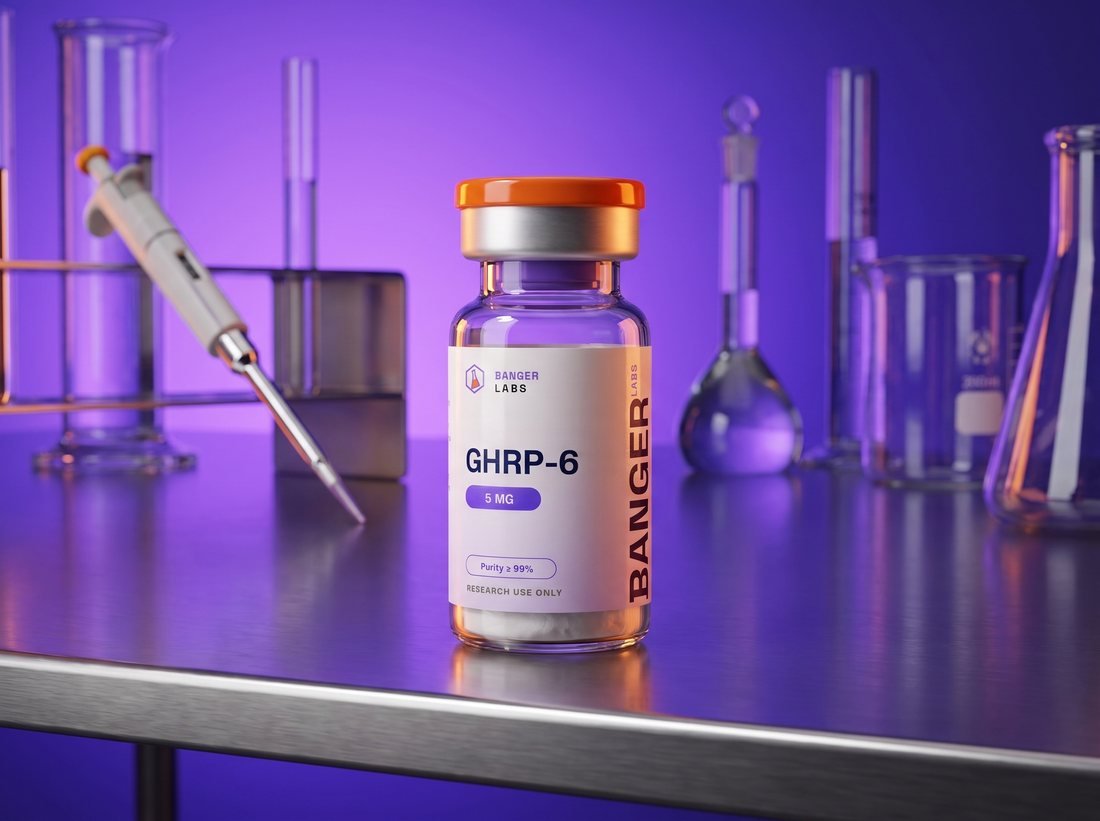
These describe laboratory/preclinical research only. No therapeutic, medical, or efficacy claims are made.
Frequently asked questions
Are GHRP-2 and GHRP-6 the same?
No — see the comparison table above; they differ in class and the research contexts in which they are studied.
Are these research use only?
Yes. Both are supplied strictly for laboratory research — not for human or veterinary use.
References
- Pralmorelin (GHRP-2) — structure, peptide class, developmental codes, and ghrelin/GHS-R agonist mechanism — Wikipedia
- Ghrelin receptor agonist, GHRP-2, produces antinociceptive effects at the supraspinal level via the opioid receptor in mice (Peptides, 2014) — PubMed (PMID 24607724)
- Ghrelin receptor agonist, GHRP-2, attenuates burn injury-induced MuRF-1 and MAFbx expression and muscle proteolysis in rats (Peptides, 2009) — PubMed (PMID 19577604)
- Pralmorelin — drug entity record (identity, class, GHS-R1a mechanism) — NCATS Inxight Drugs
- On the in Vitro and in Vivo Activity of a New Synthetic Hexapeptide that Acts on the Pituitary to Specifically Release Growth Hormone (Bowers et al., Endocrinology 1984) — Endocrinology, 1984;114(5):1537-45, PMID 6714155
- Binding of a growth hormone releasing hexapeptide to specific hypothalamic and pituitary binding sites (Codd et al., Neuropharmacology 1989) — Neuropharmacology, 1989;28(10):1139-44, PMID 2812284
- Intranasal Delivery of a Ghrelin Mimetic Engages the Brain Ghrelin Signaling System in Mice — PubMed Central, PMC11795113
- Growth hormone releasing peptide-6 (GHRP-6) and other related secretagogue synthetic peptides: a mine of medical potentialities for unmet medical needs — Integrative Molecular Medicine (OAText) review article
Shop these research peptides
By the Banger Labs Research Team. For research use only. Not for human or veterinary use. Educational information, not medical advice.